The NexStar 6SE suits observers who want a compact optical tube, computerized object finding and tracking for the Moon, planets and brighter deep-sky targets. Budget for dependable power and learn alignment before adding accessories. Choose a different mount if long-exposure deep-sky photography is the main goal.
This is a buying assessment based on manufacturer specifications and practical setup constraints, not a claim that we tested a new review sample. The strongest reason to buy the 6SE is the combination of tracking and manageable equipment. Its tradeoff is the cost and setup of electronics compared with a simple manual telescope.
Short on time? Here is what to buy
The picks from this guide. Details and trade-offs are below.
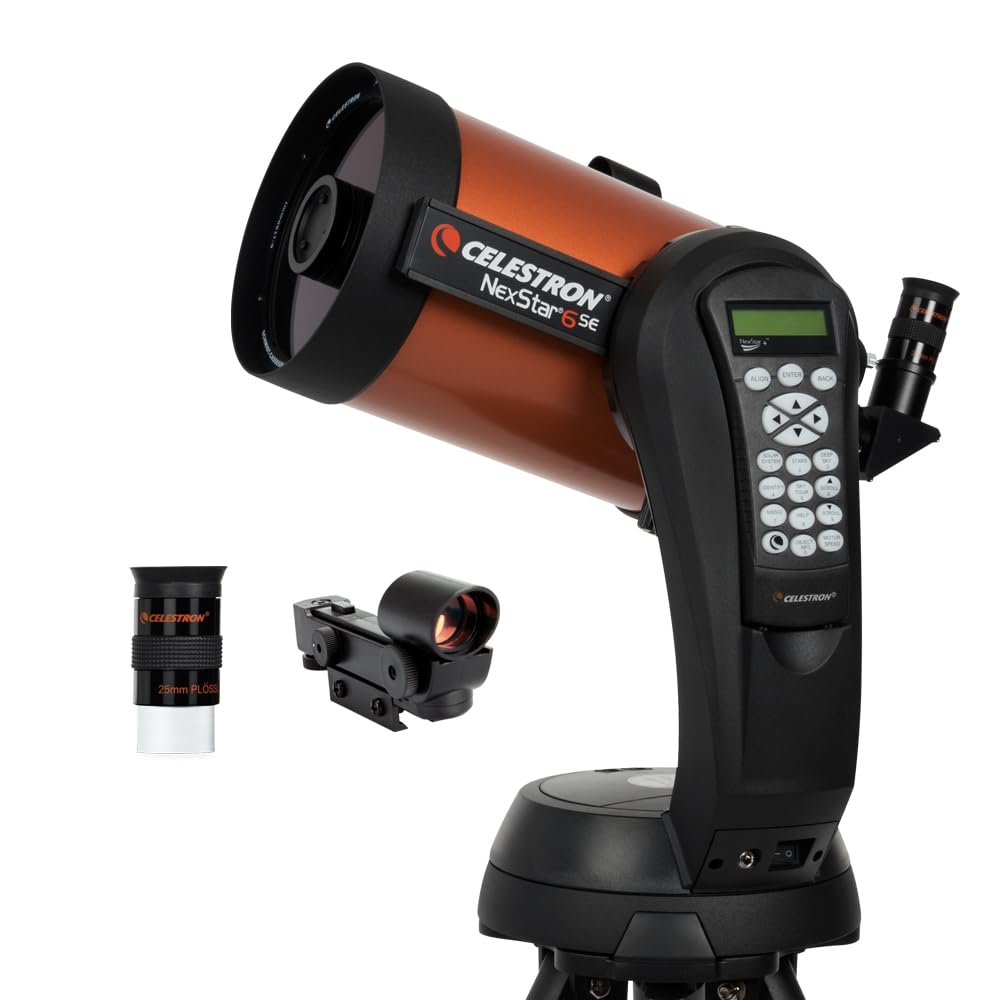 The telescope reviewed hereCelestron NexStar 6SESee today's price →
Opens the store for your region in a new tab. We may earn a commission at no extra cost to you.
The specifications that matter
Celestron's current 6SE specifications list the following. Complete kit weight and optical tube weight answer different carrying questions, so compare like with like.
| Specification | NexStar 6SE | Why it matters |
|---|---|---|
| Aperture | 150 mm | Determines the light collected and potential resolution, alongside obstruction and optical quality |
| Focal length | 1500 mm | Makes moderate to high magnification easy to reach |
| Optical tube weight | 8 lb | The part you attach to the mount |
| Listed complete telescope weight | 28 lb | A better starting point for planning transport |
| Supplied eyepiece | 25 mm | Gives 60x at the listed focal length |
| Tripod leg diameter | 1.5 inches | The tripod still needs firm placement and careful handling |
| Mount | Computerized alt-azimuth | Tracks targets, with field rotation as a limitation for longer photographic exposures |
Accessories, cases and an external battery add to the load you actually carry. If stairs or storage are a concern, measure the available space and think through separate trips before ordering.
What can you see?
The Moon is a forgiving first target. Begin with the supplied eyepiece, focus slowly, and explore the boundary between light and shadow. At higher power, poor seeing or a warm optical tube can soften detail even when the telescope is working correctly.
Jupiter's bright moons and cloud belts are suitable targets. The Great Red Spot must be on the visible side, and finer structure depends on steady air. Saturn's rings are also suitable, but their changing tilt affects the view; a clear Cassini Division is not an every-night promise. Mars is more demanding because its apparent size changes greatly with its distance from Earth.
For galaxies and nebulae, darkness and transparency matter. Expect faint visual views rather than colorful photographs. Bright clusters and double stars can be rewarding alternatives when the sky does not support a faint galaxy. Our guide to why planets look blurry helps separate atmospheric problems from focus and equipment issues.
What setup actually involves
Put the tripod on stable ground, attach the mount and tube according to the manual, connect suitable power, fit the diagonal and eyepiece, and perform the alignment procedure. SkyAlign uses the objects you center and your location and time information. The standard 6SE does not have a camera that photographs and plate-solves the sky.
The first evenings may take longer than later sessions. Entering the wrong time zone, centering poorly or losing power can prevent accurate pointing. Start with bright, recognizable targets and learn the hand controller before relying on a long list of faint objects. Keep the Celestron NexStar SE manual available during setup.
Thermal settling is separate from assembly. A telescope carried from a warm room into cold air may need longer than one moved between similar temperatures. Avoid a fixed cooldown promise; watch whether the image becomes steadier as the tube approaches outdoor temperature.
Which accessories should come first?
Use the included 25 mm eyepiece first. It gives 1500/25 = 60x. A 13–15 mm eyepiece gives about 100–115x, and a 10 mm gives 150x. An 8 mm gives about 188x; a 6 mm gives 250x and belongs to nights that support that power. More magnification is not automatically more detail.
Our 6SE and 8SE eyepiece guide includes both telescopes' magnifications so you do not buy several accessories that duplicate the same useful range. Start with a modest kit and identify an actual gap before adding a Barlow or shorter eyepiece.
Reliable power comes before an elaborate eyepiece collection. Confirm voltage, polarity and connector compatibility, and account for slewing demand. Battery runtime varies with capacity, temperature and equipment; do not assume a fixed number of hours from AA batteries. See the 6SE and 8SE power guide for compatible choices and budgeting.
A dew shield can delay dew, but weather determines whether it is enough. A heater adds electrical demand and must fit the telescope. Our dew-control guide explains the staged approach rather than promising a set dew-free duration.
Can the 6SE take photographs?
Lunar and planetary imaging are the natural starting points. A compatible phone adapter or planetary camera lets you capture short exposures or video, then select and stack usable frames. Check focus reach, attachment and computer compatibility before buying a camera. The camera shortlist separates simple entry options from more capable dedicated workflows.
The supplied alt-azimuth mount tracks an object's position but does not remove field rotation. There is no universal 30-second safe exposure: target position and image scale change the result. A wedge adds complexity and does not turn the whole setup into an effortless deep-sky imaging rig. If long-exposure deep-sky imaging is the main purchase goal, choose the mount and complete imaging system around that goal first.
For a phone, start with the Moon through a telescope and compare NexYZ and NexGO adapters. Bare-phone star photography is a different workflow from holding a phone camera precisely behind an eyepiece.
Should you buy the 8SE or a Dobsonian instead?
Celestron lists the 8SE at 32 lb complete and its tube at 12 lb, versus 28 lb and 8 lb for the 6SE. The 203.2 mm versus 150 mm aperture gives an area ratio of about 1.84 before obstruction and transmission. That is not a guarantee of 84% more visible detail: conditions, target and handling still matter.
Choose the 8SE when its larger tube and total setup suit you and you will use the extra aperture. Choose the 6SE when its lower equipment burden leaves a more workable budget and carrying routine. The complete 6SE versus 8SE comparison expands that decision without treating a changing price difference as permanent.
A manual Dobsonian often gives more aperture for the budget. Its tradeoff is manual finding and tracking, plus a different storage shape. Try handling both styles at a local astronomy event if possible; the equipment you can comfortably use has an advantage over equipment that stays indoors.
Check the complete cost before buying
Compare the telescope, delivery, power, necessary adapters and any dew control together. Confirm the exact model and return policy. We have not fixed a current price or stock claim into this guide because retailer offers change.
Check NexStar 6SE offers and compare them with the alternatives above. Purchases through affiliate links may earn TelescopeGuides a commission at no extra cost to you. The buying decision should still begin with your observing goals and complete setup.
Ready to choose?
The picks from this guide, in the order we cover them.
The telescope reviewed hereCelestron NexStar 6SESee today's price →Opens the store for your region in a new tab. We may earn a commission at no extra cost to you.
Frequently asked questions
Is the NexStar 6SE suitable for beginners?
Yes, for beginners willing to learn alignment and power management. GoTo helps find targets after successful setup; it does not remove the need to focus, enter correct location and time information, and choose suitable observing conditions.
What eyepiece should I add first?
Use the supplied 25 mm first. A 13–15 mm eyepiece provides a moderate next step, while a 10 mm gives 150x. Add higher power only after you know local conditions and the kind of detail you want to observe.
Is the 8SE much heavier?
Celestron lists 32 lb complete for the 8SE and 28 lb for the 6SE. The optical tubes are listed at 12 lb and 8 lb respectively. Cases, batteries and accessories increase the actual load.
Does the 6SE automatically align itself?
The standard package requires you to perform an alignment procedure with the hand controller. Camera-based automatic alignment requires additional compatible equipment; it is not the same as the supplied SkyAlign process.
Can I use it for long-exposure deep-sky photography?
The supplied alt-azimuth mount introduces field rotation, so treat lunar and planetary imaging as the easier starting point. Plan a dedicated mount and complete imaging setup if long-exposure deep-sky work is your main goal.