As an Amazon Associate, we earn from qualifying purchases. Check the exact model, condition, delivery and current price before ordering.
- What Jupiter looks like through a telescope
- What you see at each telescope size
- Can you see the Great Red Spot?
- Jupiter's moons in a telescope
- What magnification to use on Jupiter
- When to see Jupiter in late 2026 and 2027
- Which telescope gets you there
- Why Jupiter may look blurry
- Frequently asked questions
Through a telescope, Jupiter looks like a small, cream-colored disk crossed by two dark cloud belts, with up to four star-like moons lined up beside it. A 3-inch telescope at about 50x to 100x shows the two main belts and the moons. A 6-inch to 8-inch telescope at 150x to 200x adds thinner belts, white ovals, dark festoons and, when it is turned toward us, the Great Red Spot. This season Jupiter rises around midnight in mid-November 2026 and reaches opposition on February 10, 2027.
Our pick for seeing Jupiter's detail is the Sky-Watcher Classic 200 Dobsonian. Its 8-inch mirror reaches the 150x to 200x that brings out the belts and the Red Spot.

What Jupiter looks like through a telescope
Jupiter is the biggest planet in the eyepiece. EarthSky gives its size at the February 2027 opposition as 44.2 arcseconds, so at only 40x it already looks about as wide as the full Moon does to your naked eye. The disk is slightly flattened, wider than it is tall, and the dark stripes run parallel to its equator.
NASA calls the dark orange stripes belts and the lighter bands zones. The two you see first are the North and South Equatorial Belts, either side of a bright Equatorial Zone. Jupiter also turns fast, and NASA gives one Jupiter day as 9.9 hours. In an hour at the eyepiece the planet rotates more than a tenth of a turn, so spots and ovals visibly drift from one side to the other during an evening.
Compared with photos, the colors are soft, cream, tan and gray-brown rather than deep orange. Detail comes and goes as the air steadies, so the best view arrives in short sharp moments. Our Jupiter facts guide explains what the belts and storms are.
What you see at each telescope size
This table follows the aperture guide in BBC Sky at Night's Jupiter observing article by Paul Abel. The view on any night also depends on the steadiness of the air, so treat it as what each size can show, not what it shows every time.
| Telescope | Useful power on Jupiter | Cloud belts | Great Red Spot | Moons |
|---|---|---|---|---|
| 60mm to 80mm | 40x to 120x | Two main equatorial belts and darker poles | Only when strongly colored, and hard | Four moons as points; a moon shadow on good nights |
| 100mm to 130mm | 100x to 180x | Darker sections in the North Equatorial Belt, white ovals in the Equatorial Zone | Visible in a 4-inch when strongly orange | Moon shadows crossing the clouds |
| 150mm | 150x to 200x | Thinner temperate belts and zones, brownish tones in the main belts | Easier, with the belt around it | Moon shadows easier to catch |
| 200mm and up | 180x to 250x | Festoons across the Equatorial Zone, white ovals farther south | Structure inside the spot in larger telescopes | Moons as tiny disks |
The jump from a small refractor to an 8-inch is mostly about contrast and resolution. The belts stop being two lines and turn into a busy pattern of knots and loops. If you are deciding how big to go, our ranking of the best telescopes to see Jupiter compares nine options by aperture.
Can you see the Great Red Spot?
Yes, but only at the right time. The Great Red Spot is a storm bigger than Earth (NASA), sitting on the south side of the South Equatorial Belt. It is on the side of Jupiter facing us for roughly half of each 9.9-hour rotation, and it is easiest to see within an hour or so of crossing the middle of the disk. A planetarium app or a Great Red Spot transit table tells you when that happens.
Its color also matters. BBC Sky at Night notes that the spot "varies in colour and intensity and sometimes fades." When it is strongly orange it can show in a 4-inch telescope; when it is pale you may see only the dent it makes in the South Equatorial Belt. A light blue filter, such as Celestron's #80A, raises the contrast of the belts and the spot.
Jupiter's moons in a telescope
The four Galilean moons, Io, Europa, Ganymede and Callisto, are bright enough to show in binoculars (EarthSky). In a telescope they look like stars in a line through Jupiter's equator, and their order changes from night to night, sometimes within hours. In an 8-inch they appear as tiny disks rather than points.
The best moon show is a shadow transit, when a moon's black shadow crosses Jupiter's clouds. BBC Sky at Night says Ganymede's shadow can be seen in a 2-inch telescope under good conditions. Planetarium apps list the moon positions and shadow transits for your location.
What magnification to use on Jupiter
Magnification is the telescope's focal length divided by the eyepiece's. Jupiter shows its belts from about 40x to 50x, and BBC Sky at Night suggests around 180x as enough for fine detail on an average night. A common rule of thumb, for ideal conditions only, puts the ceiling at about 50x per inch of aperture; in practice the air sets the limit first.
| Telescope | Included eyepieces | With an 8-24mm zoom | Rule-of-thumb ceiling |
|---|---|---|---|
| 130mm, 650mm focal length | 26x and 65x | 27x to 81x (54x to 163x with a 2x Barlow) | About 255x |
| 8-inch Dobsonian, 1200mm | 48x and 120x | 50x to 150x | About 400x |
| 8-inch SCT, 2032mm | 81x | 85x to 254x | About 400x |
Use the lowest power to center Jupiter, then go up until the belt edges start to soften, and come back one step. Our guide to the magnification you need for planets covers each planet in the same way.
When to see Jupiter in late 2026 and 2027
Jupiter's oppositions come about 13 months apart. The last one was January 10, 2026 (EarthSky), so through late 2026 Jupiter is a late-night and morning planet that rises a little earlier every week. It reaches opposition again on February 10, 2027, US time, when it rises at sunset and is up all night.
| Date | What happens | Source |
|---|---|---|
| November 15 to 16, 2026 | Jupiter and Mars about 1.1° apart; look before dawn on November 15 or 16 | Scientific American |
| February 10, 2027 | Opposition on the evening of February 10 in US time zones (February 11 UTC), magnitude -2.5, 44.2 arcseconds, in Leo | EarthSky |
| After opposition | Jupiter is already up at dusk, so spring 2027 evenings are the easiest time | Follows from opposition |
Whatever the date, look when Jupiter is well above the horizon, where you see through less turbulent air. A night with twinkling stars usually means a wobbly Jupiter; a calm, slightly hazy night is often steadier.
Which telescope gets you there
The belts and moons show in any telescope. The Great Red Spot and the fine structure in the belts need 5 to 8 inches and 150x to 200x on a steady night. These options were read on Amazon US on October 27, 2026, and the full ranking is in our guide to the best telescopes to see Jupiter.
1. Sky-Watcher Classic 200 Dobsonian (best for Jupiter detail)
The Classic 200 (card at the top of this page) puts an 8-inch mirror with a 1200mm focal length on a simple rocker base. The included 25mm and 10mm eyepieces give 48x and 120x, and an 8-24mm zoom adds every step from 50x to 150x. It also has a 2-inch Crayford focuser and a 9x50 finder. Sky-Watcher lists 45 lb assembled, as a 20 lb tube and a 25 lb base. You move it by hand, so at high power you nudge it every minute or so to keep Jupiter in view.
2. Celestron StarSense Explorer DX 130AZ (phone-guided 130mm)
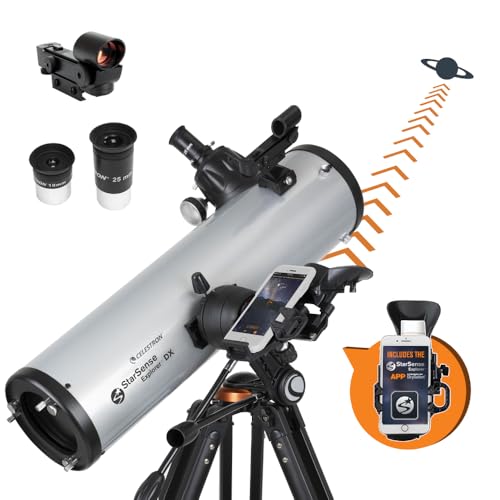
It is a 130mm f/5 reflector with 650mm focal length on a manual altazimuth mount. Your phone sits in a dock and the StarSense app shows arrows to Jupiter and its moons. The included 25mm and 10mm eyepieces give 26x and 65x, which show the main belts and the four moons. For the Red Spot, add a 2x Barlow to reach 130x, because none comes in the box.
3. Celestron NexStar 8SE (computerized 8-inch)

The 8SE has the same 8-inch aperture as the Classic 200 in a short Schmidt-Cassegrain tube with a 2032mm focal length, so the included 25mm eyepiece already gives 81x. Its computerized fork mount finds Jupiter and tracks it, which makes long sessions waiting for steady moments easier. Celestron lists 32 lb for the kit and 8 AA batteries or 12V power. On October 27, 2026 Amazon showed it sold by Focus Camera LLC (a third-party seller) in two of three reads and by Amazon.com in one, so check the seller and condition before you order.
4. Celestron 8-24mm Zoom Eyepiece (one eyepiece for every power)
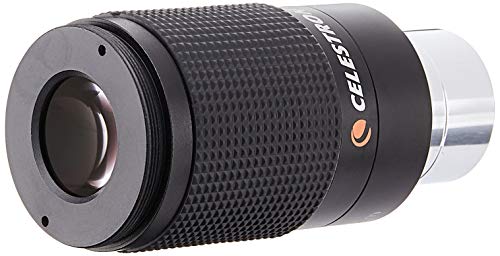
On Jupiter the best magnification changes from minute to minute with the air, and a zoom lets you follow it. Turn the barrel from 24mm to 8mm and you go from 50x to 150x on a 1200mm Dobsonian, or 85x to 254x on an 8SE. Celestron lists a 40° to 60° field across the range. More options are in our guide to the best eyepieces for viewing planets.
5. Celestron Lunar and Planetary Filter Set (more belt contrast)
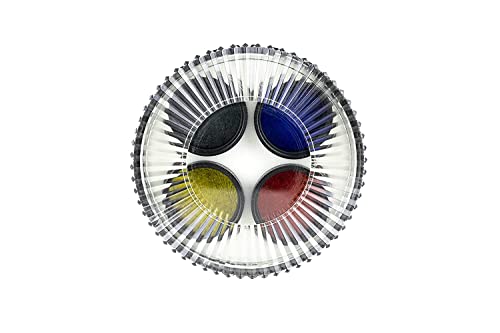
Filters do not add detail, but they can make low-contrast detail easier to see. Celestron's set contains #12 deep yellow, #21 orange, #80A light blue and a neutral density filter that passes 50% of the light. Celestron says the #80A enhances the contrast of Jupiter's cloud belts, and BBC Sky at Night suggests a light blue filter for the Red Spot and yellow as a good all-round choice. The filters thread into 1.25-inch eyepieces.
Why Jupiter may look blurry
- Too much power. Go back to the magnification where the belt edges look crisp.
- Moving air. Wait for the steady moments, or observe when Jupiter is higher.
- A warm telescope. Give it 30 minutes or more outside before judging the view.
- Glare. Jupiter is bright; a yellow or neutral density filter can make the belts easier to read.
Step-by-step fixes are in our guide to why Jupiter and Saturn look blurry, and our planet observing guide covers Mars, Venus and Saturn too.
Saturn is the other giant worth a look this season; our guide to Saturn through a telescope shows its thin 2026 rings and moons at each telescope size.
Frequently asked questions
Can you see Jupiter with a small telescope?
Yes. BBC Sky at Night says a 3-inch telescope shows Jupiter's two main equatorial belts and the polar shading, and the four Galilean moons show even in binoculars. Detail such as festoons and the Great Red Spot needs a larger telescope and a steady night.
Can you see the Great Red Spot through a telescope?
Yes, when it faces Earth and the air is steady. It is on the visible side for roughly half of each 9.9-hour rotation. When it is strongly orange a 4-inch telescope can show it; when it is pale, 6 to 8 inches and a light blue filter help.
What magnification do you need to see Jupiter?
The belts show from about 40x to 50x. Around 150x to 200x brings out finer detail, and BBC Sky at Night suggests about 180x is enough on an average night. The rule of thumb of about 50x per inch of aperture is a ceiling for ideal nights only.
When is the best time to see Jupiter in 2026 and 2027?
In late 2026 Jupiter rises around midnight; before dawn on November 15 or 16, 2026 it sits about 1.1° from Mars. Its next opposition is February 10, 2027 (US time), when it is up all night, and it stays well placed in the evening through spring 2027.
Can you see Jupiter's moons through a telescope?
Yes. Io, Europa, Ganymede and Callisto show as bright points in a line beside Jupiter, and their order changes from night to night. Their shadows crossing the planet can be seen in small telescopes on good nights.
Does Jupiter look like the pictures?
Not quite. In the eyepiece Jupiter is smaller and its colors are softer, cream and tan rather than deep orange. Online pictures are usually stacked from many video frames, which shows more color and detail than the eye sees in one look.