As an Amazon Associate, we earn from qualifying purchases. Check the exact model, condition, delivery and current price before ordering.
Through a telescope, Saturn looks like a small, pale yellow ball with a ring around it, sharp enough to recognize at 25x in a 50mm telescope. In late 2026 the rings are tipped only about 6° to 8° toward Earth, so they look like a thin, bright line across the planet rather than the wide oval in photos. A 5-inch telescope at 100x to 150x shows the rings standing clear of the globe and Saturn's largest moon, Titan; an 8-inch on a steady night adds cloud belts, ring shading and more moons.
Our pick for a first look at Saturn is the Celestron StarSense Explorer DX 130AZ. Its 130mm mirror shows the rings and Titan, and its phone app points you to Saturn.
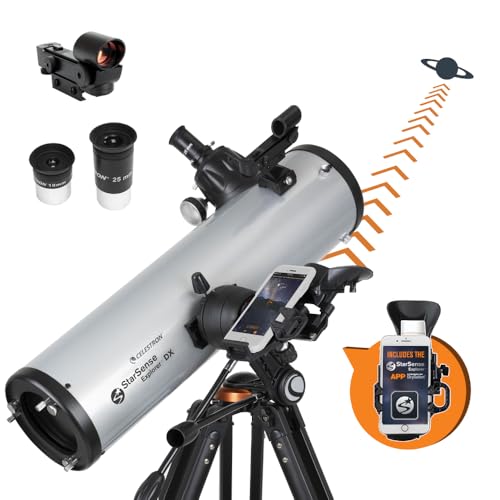
What Saturn looks like through a telescope right now
Saturn is a small target. Celestron gives its globe as about 19 arcseconds wide at the 2025 opposition. At 100x that globe looks about as wide as the full Moon does to your naked eye, and the rings stretch a little over twice as wide as the globe. You see a cream-colored disk, the ring around it, and one or more star-like moons nearby.
The big difference in 2026 is the ring angle. Earth passed through the plane of Saturn's rings on March 23, 2025, when they turned edge-on and nearly vanished. Since then they have been opening slowly. An ephemeris table published by Abrams Planetarium (data from NASA's PDS Rings Node) puts the tilt at 9.2° on July 21, 2026, falling to a low of 6.1° on December 6, 2026, before it opens again. EarthSky and BBC Sky at Night both give about 7.5° for October 2026.
So expect a narrow ellipse, almost a bright bar crossing the planet. It is a view you only get for a few years at a time. Once they open up in 2027, the rings stay wider than this until late 2037, ahead of the next edge-on crossing on October 15, 2038.
What you see at each telescope size
Aperture (the width of the main lens or mirror) decides how much detail is possible; the night's air decides how much you actually get. This table combines Celestron's and BBC Sky at Night's observing guides with the resolution math for each size. Treat it as a typical view on a decent night, not a promise.
| Telescope | Useful power on Saturn | Rings | Cassini Division | Moons |
|---|---|---|---|---|
| 50mm to 70mm | 25x to 100x | Visible as a thin ring around a tiny ball | No | Titan |
| 80mm to 130mm | 100x to 150x | Clearly separate from the globe | Unlikely at today's narrow tilt | Titan, plus fainter moons on dark nights |
| 150mm to 200mm | 150x to 250x | Sharp, with the inner B ring brighter than the outer A ring | Possible at the ring ends on steady nights | Up to about six |
| 250mm and up | 200x to 300x | Faint inner C ring possible | Easier; the narrower Encke gap needs 11 inches or more | Up to about six, more easily |
Two numbers explain the Cassini Division row. NASA gives the gap as 4,700 km wide. At Saturn's distance that is under one arcsecond, which is close to the resolving limit of a 6-inch telescope (Dawes' limit, about 116 divided by the aperture in millimeters, in arcseconds). With the rings tipped only a few degrees, the gap is also foreshortened, so look for it at the ring ends, called the ansae, where the ring is widest. Celestron's guide adds that the gap shows "when the rings are at a favorable tilt"; BBC Sky at Night calls it a good test of steady air this season. Our guide to the telescope size you need for Saturn goes deeper into the aperture choice.
How much magnification Saturn needs
Magnification is the telescope's focal length divided by the eyepiece's focal length. Rings show at 25x to 50x, but Saturn starts to look like Saturn at about 100x, and the best detail usually comes between 150x and 250x. Above that, the air on most nights blurs more than it reveals. A common rule of thumb, for ideal conditions only, puts the ceiling at about 50x per inch of aperture.
| Telescope | Included eyepieces | With a 9mm eyepiece | Rule-of-thumb ceiling |
|---|---|---|---|
| 130mm, 650mm focal length | 26x and 65x | 72x (144x with a 2x Barlow) | About 255x |
| 150mm Maksutov, 1800mm | 64x (28mm) | 200x | About 295x |
| 8-inch Dobsonian, 1200mm | 48x and 120x | 133x | About 400x |
| 8-inch SCT, 2032mm | 81x | 226x | About 400x |
Start with the lowest power to center Saturn, then step up and stop at the point where the ring edge goes soft. Our planet magnification guide gives the same numbers for Jupiter, Mars and the others.
Saturn's moons in a telescope
Celestron's guide puts the number of moons amateur telescopes can show at about six. Titan comes first. It shines at about ninth magnitude and shows in any telescope as a star-like dot a few ring-widths from the planet. Rhea, Dione and Tethys are fainter and sit closer in; Enceladus and Mimas, the hardest, need a large telescope and a dark, steady night because they hug the bright rings.
The moons move from night to night, so a planetarium app is the easiest way to name the dots you see. In years of narrow rings like this one, the moons line up close to the ring plane, which makes the row of dots easier to follow.
When to see Saturn in late 2026 and 2027
Saturn reached opposition on October 4, 2026, when it was opposite the Sun in our sky and up all night (EarthSky). Through November and December 2026 it is an evening planet, highest after dark, and the rings stay near this low point. Then they open quickly through 2027.
| Date | What happens | Ring tilt toward Earth |
|---|---|---|
| October 4, 2026 | Opposition, with Saturn up all night | About 7.5° |
| December 6, 2026 | Low point before the rings open again | 6.1° |
| August 3, 2027 | Rings at their widest for the year | 14.4° |
| October 18, 2027 | Next opposition | Between 11.7° and 14.4° |
| May 2032 | Widest of the cycle | About 27° |
| October 15, 2038 | Next edge-on crossing | 0° |
Tilt values come from the Abrams Planetarium table (Appearance of Saturn's Rings, 2025 to 2039), opposition dates from EarthSky, and the October 2026 tilt also from BBC Sky at Night. The minus sign in those tables only means we see the south face of the rings, which stays true until 2038. For the best view on any night, wait until Saturn is high in the sky, away from the haze and turbulence near the horizon.
Which telescope gets you there
Any telescope from 50mm up shows the rings. The step that changes the view is 5 to 8 inches of aperture with enough focal length, or a Barlow, to reach 150x to 250x. Here are the options that cover that range, read on Amazon US on October 27, 2026. Our full planet telescope rankings list more.
1. Celestron StarSense Explorer DX 130AZ (best first Saturn telescope)
The StarSense Explorer DX 130AZ (card at the top of this page) is a 130mm f/5 reflector with 650mm focal length on a manual altazimuth mount. Your phone sits in a dock and the StarSense app shows arrows that guide you to Saturn. The included 25mm and 10mm eyepieces give 26x and 65x, enough to see the rings and Titan. For the 100x to 150x that Saturn rewards, add a 2x Barlow or a short eyepiece, because there is none in the box.
2. Sky-Watcher Classic 200 Dobsonian (most aperture for Saturn)

An 8-inch mirror gathers about two and a half times the light of a 130mm and resolves finer detail, which is the jump that brings the Cassini Division, the shading between the A and B rings and Saturn's faint cloud belts into reach. The Classic 200 has a 1200mm focal length, a 2-inch Crayford focuser, a 9x50 finder, and 25mm and 10mm eyepieces (48x and 120x). Sky-Watcher's listing gives 45 lb fully assembled, split into a 20 lb tube and a 25 lb base. There is no app or motor, so you nudge it to keep Saturn in view, which at 150x to 200x means a small push every minute or so.
3. Celestron NexStar 8SE (computerized 8-inch for high power)

The 8SE puts an 8-inch (203mm) Schmidt-Cassegrain on a computerized fork mount. Its 2032mm focal length gives 81x with the included 25mm eyepiece and 226x with a 9mm, without a Barlow, and the mount tracks Saturn so it stays centered while you look. Celestron lists 32 lb for the kit and 8 AA batteries or 12V power. On October 27, 2026 Amazon showed it sold by Focus Camera LLC (a third-party seller) in two of three reads and by Amazon.com in one, so check the seller and condition before you order.
4. Sky-Watcher Skymax 150 Maksutov (high power on a mount you own)
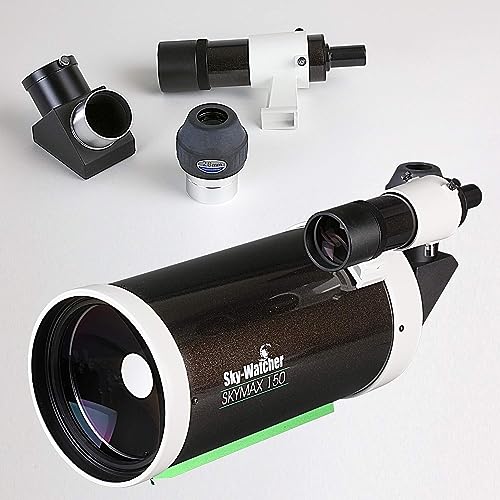
A Maksutov's long focal length makes planet power easy, and 1800mm at f/12 gives 200x with a 9mm eyepiece. The listing includes a 28mm 2-inch eyepiece, a 2-inch diagonal, a 9x50 finder and a Vixen-style dovetail. It is a tube only, with no mount or tripod, so it fits readers who already own a mount rated for its weight. A closed tube like this one needs time outdoors to cool before the view settles.
5. Celestron X-Cel LX 9mm (the eyepiece that adds Saturn power)

If you already own a telescope, an eyepiece may be the simplest way to a better Saturn. A 9mm gives 133x on a 1200mm Dobsonian, 111x on a 1000mm telescope and 226x on an 8SE. The X-Cel LX lists a 60° field, six lens elements and 16mm of eye relief, which leaves room for eyeglasses. More choices are in our guide to the best eyepieces for viewing planets.
Why Saturn may look small or blurry
- Too much power. Drop the magnification until the ring edge is crisp. A small sharp Saturn shows more than a big soft one.
- Unsteady air. When the view boils, wait for calm moments or try later in the night when Saturn is higher.
- Warm optics. A telescope brought out from a warm house needs 30 minutes or more to settle.
- Expecting a photo. Pictures online are stacked from thousands of video frames; the eyepiece view is smaller and paler.
Our guide to why Jupiter and Saturn look blurry walks through each fix, and the planet observing guide covers the other planets.
Jupiter is the other giant worth a look this season; our guide to Jupiter through a telescope shows its belts, Great Red Spot and moons at each telescope size.
Frequently asked questions
Can you see Saturn's rings with a small telescope?
Yes. Celestron says a 50mm telescope at 25x is enough to show Saturn's rings. In late 2026 they are tipped only about 6° to 8°, so a small telescope shows them as a thin line across the planet rather than a wide oval.
Why do Saturn's rings look so thin in 2026?
Earth passed through the plane of the rings on March 23, 2025, when they were edge-on. They opened to 9.2° on July 21, 2026, are narrowing to a low of 6.1° on December 6, 2026 (about 7.5° in October), then open to 14.4° by August 2027 and about 27° in 2032.
What magnification do you need to see Saturn?
Rings show at 25x to 50x, Saturn looks detailed from about 100x, and the best views usually come at 150x to 250x on a 5-inch to 8-inch telescope. The rule of thumb of about 50x per inch of aperture is a ceiling for ideal nights only.
When is the best time to see Saturn through a telescope?
Saturn reached opposition on October 4, 2026 and stays an evening planet through late 2026. Look when it is highest in the sky, on a calm night. The next opposition is October 18, 2027, with the rings tipped more than 11° toward us.
Can you see Saturn's moons through a telescope?
Yes. Titan, at about ninth magnitude, shows in any small telescope as a star-like dot near the planet. Celestron says amateur telescopes can show about six of Saturn's moons in total, with the fainter ones needing more aperture and dark skies.
Does Saturn look like the pictures?
Not quite. In the eyepiece Saturn is small, pale yellow and sharp-edged, with the rings and maybe a dark band on the globe. Online pictures are usually made by stacking many video frames, which reveals far more color and detail than the eye sees in one look.