As an Amazon Associate, we earn from qualifying purchases. Check the exact model, condition, delivery and current price before ordering.
- Quick picks
- 1. Celestron Eyepiece, Barlow & Filter Kit: best all-round kit
- 2. Celestron 8-24mm Zoom Eyepiece: best single upgrade
- 3. Celestron AstroMaster Accessory Kit: best budget kit
- 4. Celestron PowerSeeker Accessory Kit: simplest add-on
- Which kit fits your telescope
- How to choose an eyepiece kit
- Is the Celestron eyepiece and filter kit worth it?
- Frequently asked questions
Most beginner telescopes come with one or two basic eyepieces. An eyepiece kit fills the gaps: a low power to find things, a medium power for star clusters, and a high power for the Moon and planets, usually with a Barlow lens and a few filters in a case. The right kit depends on your telescope's focal length, so this guide shows the magnifications each one gives.
Our pick for most beginners: the Celestron Eyepiece, Barlow & Filter Kit. Five Plössl eyepieces and a 2x Barlow give ten magnifications in one case.

Quick picks
- Best all-round kit: Celestron Eyepiece, Barlow & Filter Kit, five eyepieces plus a Barlow.
- Best single upgrade: Celestron 8-24mm Zoom Eyepiece, one eyepiece that covers low to high power.
- Best budget kit: Celestron AstroMaster Accessory Kit, two eyepieces, a Barlow and three filters.
- Simplest add-on: Celestron PowerSeeker Accessory Kit, two medium and high power eyepieces.
1. Celestron Eyepiece, Barlow & Filter Kit: best all-round kit
This is Celestron's most complete 1.25-inch kit. You get five 1.25-inch Plössl eyepieces (32mm, 17mm, 13mm, 8mm and 6mm, each with a 52° field), a 2x Barlow lens, six colored planetary filters, a Moon filter, and a foam-lined aluminum case with room for more. With the Barlow, Celestron counts ten different magnifications.
The 32mm is a real bonus: it gives about the widest view a 1.25-inch focuser allows, which makes finding objects much easier. The weak spots are the 8mm and 6mm, which have short eye relief, so you have to hold your eye close; eyeglass wearers may struggle. The Moon filter is the most generally useful of the filters; the colored ones make smaller differences on planets.
2. Celestron 8-24mm Zoom Eyepiece: best single upgrade
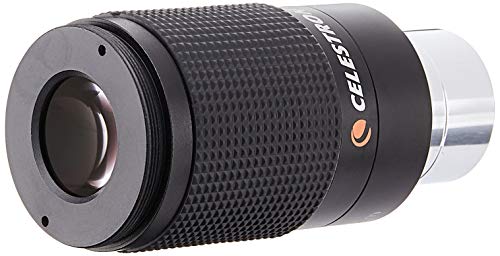
If you would rather not carry a case of eyepieces, one zoom replaces most of a kit. Twist the barrel from 24mm to 8mm and the magnification changes without swapping eyepieces; on a 650mm telescope that is about 27x to 81x, and on a 1200mm Dobsonian about 50x to 150x. Celestron lists a 40° to 60° field: narrower than a good fixed eyepiece at the 24mm end, wider at 8mm.
Pair it with your telescope's low-power eyepiece for finding things, and you have a complete set. It works with a 2x Barlow for planets on steady nights. More detail in our zoom eyepiece guide.
3. Celestron AstroMaster Accessory Kit: best budget kit
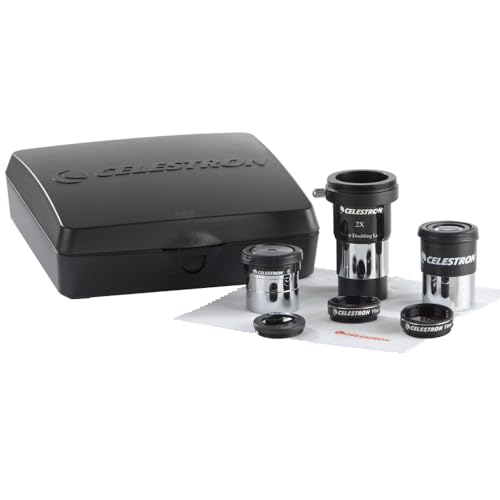
Made for the AstroMaster series but usable in any telescope with a 1.25-inch focuser. The 15mm Kellner adds a medium power, the 6mm Plössl a high power, and the 2x Barlow (with T-threads for a camera adapter) doubles both. Filters are blue, red and Moon. With the Barlow, that is four new magnifications.
It is a good match for a telescope that came with only a 20mm or 25mm eyepiece. On short focal length telescopes, check that the 6mm with the Barlow does not push past your useful limit (see the table below).
4. Celestron PowerSeeker Accessory Kit: simplest add-on

The smallest Celestron kit: a 15mm and a 9mm Kellner eyepiece, three filters, a cleaning cloth and a case, with no Barlow. Its value is the 9mm, a sensible high power for many beginner telescopes. If you own a PowerSeeker 127EQ, the 9mm (about 111x on that telescope) is a more usable high power than the 127EQ's 4mm (250x); see our PowerSeeker 127EQ review.
Which kit fits your telescope
Magnification is your telescope's focal length divided by the eyepiece's focal length. Under ideal conditions, a common rule of thumb puts the maximum at about twice your aperture in millimeters; how much you can really use depends on the night's air and is often lower. Here is what the kit eyepieces give on three common telescopes:
| Eyepiece | 650mm (130mm f/5) | 1000mm (114mm or 127mm) | 1200mm (8-inch Dobsonian) |
|---|---|---|---|
| 32mm | 20x | 31x | 38x |
| 17mm | 38x | 59x | 71x |
| 15mm | 43x | 67x | 80x |
| 13mm | 50x | 77x | 92x |
| 9mm | 72x | 111x | 133x |
| 8mm | 81x | 125x | 150x |
| 6mm | 108x | 167x | 200x |
A 2x Barlow doubles any number in the table. On a 650mm telescope, the 6mm with a Barlow gives about 217x, near the ideal-conditions rule of thumb for a 130mm mirror; on a 1200mm Dobsonian the same pair gives 400x, at that rule-of-thumb ceiling for an 8-inch and usable only on exceptional nights, if at all.
How to choose an eyepiece kit
- Check the barrel size. Almost every beginner telescope takes 1.25-inch eyepieces, and every kit here is 1.25-inch. Only larger telescopes add a 2-inch focuser.
- Aim for three powers, not ten. A low power (about 25x to 40x) to find things, a medium power (about 80x to 100x), and a high power (about 150x) covers most targets. Our eyepiece guide explains why.
- Avoid duplicates with the Barlow. A 2x Barlow on a 20mm gives the same power as a 10mm. Pick eyepieces whose Barlowed powers fall between the others.
- Mind the eye relief if you wear glasses. Short Plössls (6mm, 8mm) make you press your eye close; a zoom or wide-angle design is more comfortable.
- Treat color filters as extras. A Moon filter is useful; colored filters make small differences on planets, and they need eyepieces with filter threads.
Is the Celestron eyepiece and filter kit worth it?
For a telescope that came with one or two eyepieces, it is a convenient way to get a full range of magnifications, a Barlow and a case in one purchase. The eyepieces and Barlow fit any 1.25-inch focuser; the filters screw into eyepieces with standard 1.25-inch filter threads. It is less worth it if you already own a 25mm and a 10mm, because several kit powers would repeat what you have; then a single zoom or one quality eyepiece adds more. Forum opinions are mixed: some owners call it good value, while others prefer fewer, better eyepieces.
Frequently asked questions
What eyepieces should a beginner have?
Three: a low-power eyepiece to find objects, a medium power for clusters and nebulae, and a high power for the Moon and planets. With a 650mm telescope that could be a 25mm, a 9mm and a 6mm, or one 8-24mm zoom plus the 25mm that came with the telescope.
Are eyepiece kits worth it?
A kit can be worth it when your telescope came with one or two eyepieces: you get several magnifications in one purchase, and the larger kits add a Barlow, filters and a case. If you already have a basic set, one better eyepiece may improve your views more than a kit.
Do eyepiece kits fit all telescopes?
Every eyepiece on this page uses the standard 1.25-inch barrel, which fits almost all beginner and intermediate telescopes. Check your focuser size before ordering; filters also need eyepieces with standard filter threads.
What is the best eyepiece for viewing planets?
One that gives about 120x to 200x on your telescope, for example a 6mm to 8mm on a 1200mm Dobsonian. Our guide to the best eyepieces for viewing planets covers premium options.