This guide exists because readers asked for it. After our beginner eyepiece guide, several of you wrote in with the same question: "Fine for a first upgrade — but what about the good stuff? Tele Vue, Pentax, Masuyama?" Fair. Here it is.
Quick verdict: the shortlist
If you want the one-paragraph answer: the Tele Vue Delos line is the safest premium buy for most telescopes — 72° field, huge 20mm eye relief, sharp to the edge even in fast scopes. Glasses wearers and comfort-first observers should compare the Pentax XW first. If you want maximum field on a budget-of-the-premium-world, the Nagler Type 6 gives you 82° in a tiny package. And if money is genuinely no object, the Ethos is the last eyepiece conversation you'll ever need to have.
Are premium eyepieces actually worth it?
Honest answer: it depends on your telescope's focal ratio more than on your budget.
In a slow scope (f/8–f/15 — most Maksutovs, SCTs and long refractors), the light cone is gentle and even modest eyepieces stay sharp across the field. Premium glass buys you comfort and contrast there, but the optical gap is moderate.
In a fast scope (f/4–f/6 — most Dobsonians and imaging Newtonians), the steep light cone ruthlessly exposes cheap wide-angle designs: stars near the edge grow wings, seagulls and blur. This is exactly where premium eyepieces earn their price — they hold star points sharp across the entire field. The faster your scope, the stronger the case for premium glass.
Two more things the spec sheets undersell: eye relief (20mm on the Delos/XW means you can observe with glasses on, or just without jamming your eyeball into the lens) and mechanical quality — these are buy-once-cry-once instruments that outlive several telescopes and hold resale value remarkably well.
Comparison table
| Eyepiece | Field of view | Eye relief | Barrel | Best for | Price band |
|---|---|---|---|---|---|
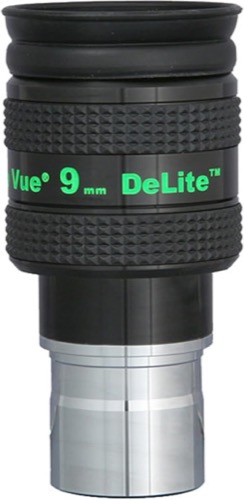
| Tele Vue DeLite 9mm | 62° | 20mm | 1.25" | First premium; planets & Moon | $$ |
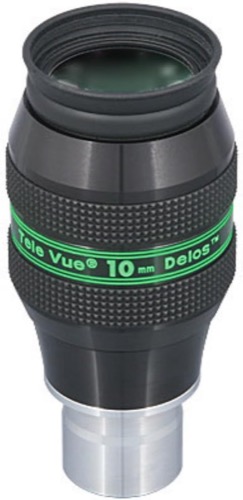
| Tele Vue Delos 10mm | 72° | 20mm | 1.25" | The do-everything benchmark | $$$ |
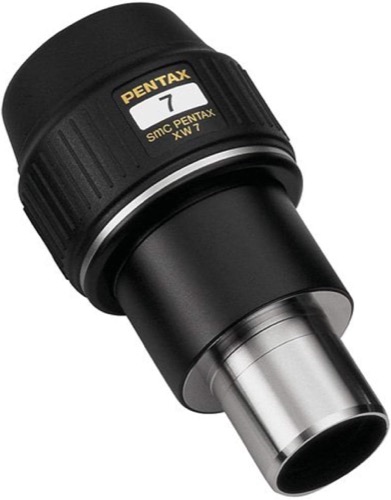
| Pentax XW 7mm | 70° | 20mm | 1.25" | High power in comfort; glasses wearers | $$$ |
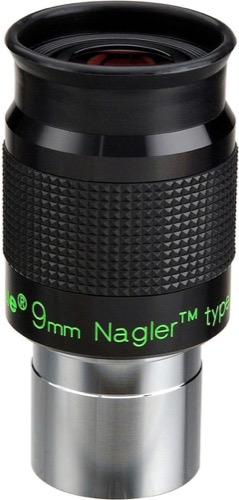
| Tele Vue Nagler Type 6 9mm | 82° | tight | 1.25" | Widest field per dollar | $$$ |
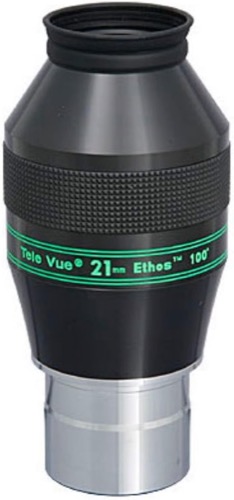
| Tele Vue Ethos 21mm | 100° | 15mm | 2" | Deep-sky endgame, fast Dobs | $$$$ |
Price bands instead of exact numbers because premium eyepiece pricing moves around — always check the current price. Roughly: $$ ≈ $250–320, $$$ ≈ $330–450, $$$$ ≈ $800+.
Tele Vue DeLite: the entry ticket to true premium
The DeLite line is how most people find out what the fuss is about without committing Delos money. 62° field, the same full 20mm eye relief as its bigger siblings, and Tele Vue's contrast and polish in a compact, light package that won't unbalance a small scope.
The field is narrower than everything else on this page — that's the trade. On planets, the Moon and double stars, you won't miss it.
Tele Vue Delos: the benchmark everyone compares against
Ask experienced observers to name one "if you could only keep one" eyepiece line and the Delos comes up more than anything else. 72° apparent field, 20mm of eye relief with an adjustable eye guard, and edge-to-edge sharpness that holds up in fast Dobsonians where lesser designs fall apart.
It is not small and not cheap — but it is the reference point. If you buy one premium eyepiece and pick the focal length you use most, this is the low-regret choice.
Pentax XW: the comfort king
The XW line is the Delos's great rival, and among observers who wear glasses it often wins: 70° field, a consistently comfortable 20mm of eye relief, and famously easy eye placement — no blackouts, no hunting for the exit pupil. Contrast and transmission are world class.
The 7mm is the sweet spot for high-power lunar and planetary work in most scopes. If you already own Pentax XWs, you know exactly why they never come up for sale second-hand.
Nagler Type 6: the original spacewalk, miniaturized
The 82° Nagler is the eyepiece that invented the "spacewalk" feeling, and the Type 6 packs it into a body barely bigger than a Plössl. In a Dobsonian without tracking, that extra field is not a luxury — it's more time watching the object before you nudge the tube.
The honest trade-off: eye relief is tight. If you observe with glasses, look at the Delos or XW instead. If you don't, the immersion per dollar here is unmatched.
Ethos: the endgame
100° apparent field. The view stops feeling like looking through an instrument and starts feeling like a porthole. The 21mm Ethos in a fast Dobsonian on a dark night is, for many observers, the single most memorable view money can buy — and at over 2 pounds of glass, it's also a commitment your focuser and your wallet both feel.
Nobody needs an Ethos. That was never the point.
What about Masuyama?
Readers with refined taste keep asking about Masuyama — the classic Japanese design with up to 85° fields and a devoted following among planetary observers for its transparency and natural rendering. The honest logistics: Masuyamas are made in small batches and mostly sold through specialty astronomy dealers rather than Amazon, so availability comes and goes. If you find one in the focal length you want, they are keepers — but we only link to products we can point you to reliably, so no card here.
Which should you buy?
- Fast Dobsonian (f/4–f/6): this is where premium matters most. Delos or Nagler for 1.25", Ethos 21 if you're going all-in on deep sky.
- SCT or Maksutov (f/10+): your scope is kind to eyepieces — prioritize comfort. DeLite or Pentax XW.
- You wear glasses: Delos, DeLite or XW (all 20mm eye relief). Skip the Nagler.
- One eyepiece, no regrets: Delos in your most-used focal length. Buy once, keep forever.
Not sure which focal length fits your telescope and skies? That's exactly what the Personal Telescope Recommendation covers — or start with the eyepiece sizes guide if you're earlier in the journey.
Frequently Asked Questions
Are premium eyepieces worth it on a cheap telescope?
Usually not first. If your telescope cost under ~$300, the next $300 is better spent on the scope itself or on our mid-tier picks. Premium eyepieces make sense once the telescope is no longer the limiting factor — with one exception: they outlive telescopes, so buying one early isn't wasted, just early.
Tele Vue Delos vs Pentax XW — which one?
Optically they trade blows. Delos has a slightly wider field (72° vs 70°); XW is renowned for easier eye placement and comfort. Glasses wearers and comfort-first observers tend to land XW; fast-Dob owners chasing edge sharpness tend to land Delos. There is no wrong answer between them.
Do I need 2" eyepieces?
Only for low-power wide fields (roughly 30mm+ focal lengths, or the big 100° designs like the Ethos 21). Your high-power eyepieces can stay 1.25" forever.
Why is eye relief such a big deal?
Eye relief is how far your eye can sit from the lens and still see the whole field. Under ~12mm you're pressed against the eyepiece — impossible with glasses, tiring without. The 20mm on the Delos, DeLite and XW is why people describe them as "effortless".