As an Amazon Associate, we earn from qualifying purchases. Check the exact model, condition, delivery and current price before ordering.
- Quick verdict
- PowerSeeker 127EQ at a glance
- The catch: 1000mm of focal length in a 17-inch tube
- What you can actually see
- The magnification trap
- The mount and tripod
- Who should still buy it
- Already own one? Five ways to get better views
- Better telescopes if you can spend more
- PowerSeeker 127EQ vs AstroMaster 130EQ vs StarSense DX 130AZ
- Frequently asked questions
The Celestron PowerSeeker 127EQ is one of the most reviewed budget telescopes (Celestron's own page lists over 9,000 reviews), and its 127mm (5-inch) mirror sounds like a lot of telescope for the money. It does show the Moon's craters, Saturn's rings and Jupiter's moons. But its short-tube optics, eyepieces and light mount make those views harder to get than they should be.
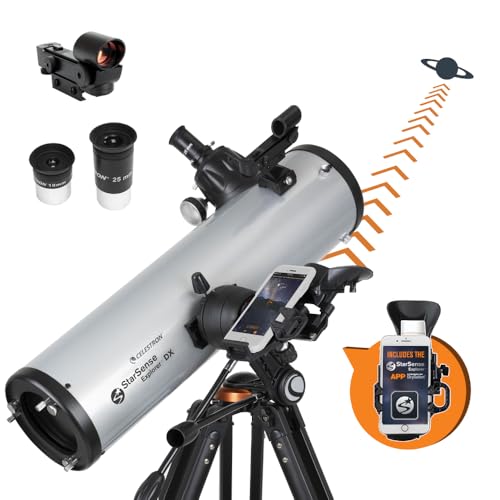
Our verdict: buy it only if you find it well below its usual price or already have one. If you can spend more, the Celestron StarSense Explorer DX 130AZ has a parabolic 130mm mirror and a phone app that shows you where to point.
Quick verdict
- Good: 127mm of aperture, a full-height tripod, a 2-year Celestron warranty, and it is easy to find in stock.
- Not good: a spherical mirror with a corrector lens in the focuser (a "Bird-Jones" design), a 4mm eyepiece that is far too strong, and a light mount that shakes at high power.
- Who it suits: someone who got it as a gift or found it cheap, and is willing to learn an equatorial mount.
- If you can spend more: a StarSense Explorer (parabolic mirror, and a phone app shows you where to point), or the AstroMaster 130EQ (same style of mount, simpler optics but still a spherical mirror).
PowerSeeker 127EQ at a glance
These are Celestron's published specifications for the PowerSeeker 127EQ (item 21049):
| Spec | PowerSeeker 127EQ |
|---|---|
| Optical design | Newtonian reflector, spherical primary mirror |
| Aperture | 127mm (5 inches) |
| Focal length / ratio | 1000mm, f/7.87 |
| Tube length | 436mm (17.2 inches) |
| Eyepieces | 20mm (50x) and 4mm (250x), plus a 3x Barlow lens |
| Finder | 5x24 finderscope |
| Highest useful magnification | 300x (Celestron's figure) |
| Mount | Manual German equatorial with slow-motion knobs |
| Total kit weight | 13 lbs (5.9 kg) |

The catch: 1000mm of focal length in a 17-inch tube
Look at two numbers in the table: a 1000mm focal length and a 436mm tube. A plain Newtonian needs a tube roughly as long as its focal length. The PowerSeeker reaches 1000mm by using a short spherical mirror and a small corrector lens inside the focuser, which works like a built-in Barlow. Telescope makers call this a Bird-Jones design.
The idea can work, but on a budget telescope it causes two practical problems:
- Softer high-power views. Any small error in the cheap corrector or the spherical mirror shows up when you push the magnification on planets.
- Hard collimation. Every Newtonian needs its mirrors aligned now and then. With a lens in the focuser, the usual tools and the reflections you line up look tiny and confusing, so many owners never get it right.
The three alternatives below avoid the corrector lens: they are f/5 Newtonians with a 650mm focal length and nothing in the focuser. The two StarSense models also use a parabolic mirror; the AstroMaster 130EQ keeps a spherical one.
What you can actually see
On a clear, steady night, a well-aligned PowerSeeker 127EQ shows:
- The Moon: craters, mountain ranges and the shadow line in sharp detail at 50x to 100x. This is where the telescope looks its best.
- Jupiter: the two main cloud belts and the four bright moons.
- Saturn: the rings clearly separated from the planet, and its largest moon, Titan.
- Bright deep-sky objects: the Orion Nebula, the Pleiades, and star clusters such as the Hercules cluster as a fuzzy ball. Galaxies like Andromeda show as faint smudges from a dark site.
For a fuller list by aperture, see what you can see with a 114mm telescope; a 127mm mirror shows a little more of the same.
The magnification trap
The box combines the eyepieces and the 3x Barlow into big numbers. Here is what each combination really gives, measured against Celestron's own 300x limit:
| Combination | Magnification | Usable? |
|---|---|---|
| 20mm eyepiece | 50x | Yes, the best place to start |
| 20mm + 3x Barlow | 150x | Yes, on steady nights for planets |
| 4mm eyepiece | 250x | Rarely; the image is dim, shaky and blurred by the air |
| 4mm + 3x Barlow | 750x | No, two and a half times the useful limit |
With this telescope, 100x to 150x is a practical range to start with; how far you can push depends on how steady the air is that night. The tiny 4mm eyepiece also has almost no eye relief, so you have to press your eye against it. A single 9mm or 10mm eyepiece (about 100x) is the most useful upgrade you can make.
The mount and tripod
The 127EQ sits on a manual German equatorial mount. Once its polar axis points at the celestial pole (near the North Star, in the Northern Hemisphere), you follow an object across the sky by turning one slow-motion knob instead of two. That is a real skill worth learning, but it confuses many first-time owners, who expect to move the telescope up, down, left and right.
The bigger problem is stiffness. The lightweight tripod legs and small mount let the image shake for a few seconds after each touch, and the shaking gets worse as magnification rises. Expect to wait for it to settle, especially at 150x.
Who should still buy it
The PowerSeeker 127EQ still makes sense in a few cases:
- You find it used or on a deep discount and mainly want to look at the Moon and bright planets.
- You want to learn how an equatorial mount works before buying a bigger one.
- It was a gift, and you want to get the most out of it (next section).
If you are buying new for a beginner, especially a child, consider one of the alternatives below if the budget allows: easier aiming and sharper optics make the first nights less frustrating.
Already own one? Five ways to get better views
- Start with the 20mm eyepiece every time. Find the target at 50x, center it, then try 150x with the Barlow.
- Put the 4mm eyepiece away. Replace it with a 9mm or 10mm Plössl; see our telescope eyepiece guide.
- Let the telescope cool for 30 minutes outside before looking at planets; a warm mirror blurs the image.
- Align the finder in daylight on a distant treetop, or swap it for a red dot finder from our red dot finder guide.
- Collimate carefully, or not at all. If stars look like comets even when focused, check the alignment with a simple collimation cap. If you are unsure, a local astronomy club can help.
Better telescopes if you can spend more
All three cost more than the PowerSeeker 127EQ, and all three were in stock and sold by Amazon.com when we checked on October 22, 2026. Each is a 130mm f/5 Newtonian with a 650mm focal length, so there is no corrector lens to fight with.
Celestron StarSense Explorer DX 130AZ: our pick if you can spend more
A 130mm parabolic mirror on a full-height manual alt-azimuth mount, plus the StarSense app (see it on Amazon; the card is at the top of this page). It is the most expensive of the three; in return it moves up, down, left and right, and the app does the finding.
Celestron StarSense Explorer 130mm Tabletop: easiest to aim
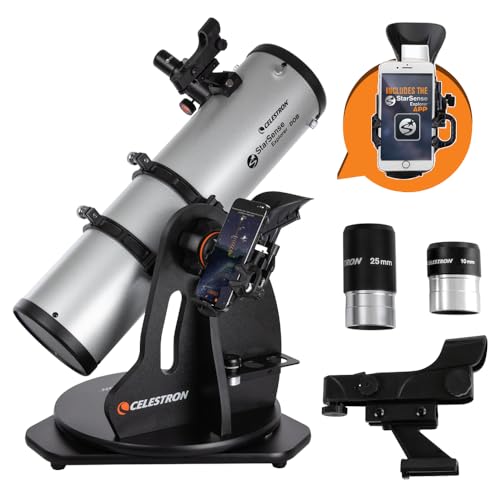
The same kind of 130mm parabolic-mirror Newtonian on a small Dobsonian-style base that sits on a table or stool. You clip your phone to it, and the StarSense app shows arrows that lead you to each object. No polar alignment, no setting circles. It needs a sturdy table outside, and the app requires a compatible smartphone.
Celestron AstroMaster 130EQ: the closest like-for-like upgrade

The same idea as the PowerSeeker with fewer compromises: a slightly larger 130mm mirror, a CG-3 equatorial mount, a red dot finder that is easy to aim, and 20mm and 10mm eyepieces (33x and 65x) instead of the 4mm. Its mirror is still spherical (Celestron's specification), so it shares a limit at high power, but there is no corrector lens in the focuser and collimation is simpler. Read our full AstroMaster 130EQ review.
PowerSeeker 127EQ vs AstroMaster 130EQ vs StarSense DX 130AZ
| Spec | PowerSeeker 127EQ | AstroMaster 130EQ | StarSense DX 130AZ |
|---|---|---|---|
| Aperture | 127mm | 130mm | 130mm |
| Primary mirror | Spherical, plus corrector lens | Spherical | Parabolic |
| Focal length | 1000mm (with corrector lens) | 650mm | 650mm |
| Tube length | 17.2 in | 21.7 in | 25 in |
| Eyepieces | 20mm, 4mm, 3x Barlow | 20mm, 10mm | 25mm, 10mm |
| Finder | 5x24 finderscope | Red dot finder | Red dot finder + StarSense app |
| Mount | Manual German equatorial | CG-3 equatorial | Manual alt-azimuth |
| Kit weight | 13 lbs | 17 lbs | 18 lbs |
Specifications from Celestron's product pages, checked October 22, 2026.
Frequently asked questions
Is the Celestron PowerSeeker 127EQ good for beginners?
It can show beginners the Moon, Saturn's rings and Jupiter's moons, but its equatorial mount, shaky tripod and hard-to-collimate optics can make it frustrating. If the budget allows, a phone-guided StarSense Explorer with a parabolic mirror is easier to use.
Can you see Saturn's rings with the PowerSeeker 127EQ?
Yes. Saturn's rings are clearly visible at 50x with the 20mm eyepiece and look larger at 150x with the 3x Barlow on a steady night.
What is the best magnification for the PowerSeeker 127EQ?
Use 50x (the 20mm eyepiece) to find objects and 100x to 150x for the Moon and planets, depending on the night. The 4mm eyepiece (250x) is rarely usable, and the 4mm with the Barlow (750x) is far beyond the telescope's 300x limit.
Can you do astrophotography with the PowerSeeker 127EQ?
You can take phone snapshots of the Moon by holding a phone or a phone adapter to the eyepiece. The mount does not track automatically as supplied, so long exposures of galaxies and nebulae are not practical.