As an Amazon Associate, we earn from qualifying purchases. Check the exact model, condition, delivery and current price before ordering.
- Quick picks
- How a white-light solar filter works
- Film or glass?
- How to size a solar filter to your telescope
- 1. Celestron EclipSmart filter for 127mm and 130mm reflectors
- 2. Celestron EclipSmart Universal Solar Filter: for small refractors and spotting scopes
- 3. Celestron EclipSmart filter for AstroMaster 70
- 4. Celestron EclipSmart 8" (and 6") for Schmidt-Cassegrains
- 5. Seymour Solar Helios glass: the glass option
- Solar filters for binoculars and cameras
- What not to buy
- Frequently asked questions
- Sources
A solar filter for a telescope is a sheet of coated film or glass that mounts over the front of the telescope and blocks almost all of the Sun's light before it enters the tube. The only safe kind for white-light viewing mounts securely over the front, fits your telescope's exact size, and comes from a maker on the American Astronomical Society's list of suppliers of safe solar filters.
This guide explains how these filters work, film versus glass, how to size one to your telescope, filters for binoculars and cameras, and what never to buy. Every product below was checked on Amazon US on October 22, 2026. Each one was in stock, sold by Amazon.com or by the maker, and made by a company on the AAS list.
Our pick for beginner reflectors: the Celestron EclipSmart filter for 127mm and 130mm telescopes, which fits several Celestron beginner models and straps on over the front of the tube.
Quick picks
- For 127mm and 130mm reflectors: Celestron EclipSmart filter for 127mm and 130mm reflectors.
- For small refractors and spotting scopes: Celestron EclipSmart Universal Solar Filter, adjustable for an outside diameter of 75mm to 100mm. For cameras, read Celestron's restrictions in its section first.
- For the AstroMaster 70: Celestron EclipSmart filter for AstroMaster 70 refractors.
- For 6-inch and 8-inch Schmidt-Cassegrains: the EclipSmart 6" and EclipSmart 8" filters.
- For glass instead of film: Seymour Solar Helios glass filter, sold in sizes by tube diameter.
- No telescope at all: Celestron EclipSmart 10x42 solar binoculars, with the filters built in.
How a white-light solar filter works
A white-light solar filter is a thin film or a sheet of glass with a reflective metal coating. It sits in front of the main lens or mirror, so the sunlight is cut down before the telescope gathers and concentrates it. What reaches your eye is a dim, safe image of the Sun's disk, showing sunspots and, during an eclipse, the Moon's edge moving across the Sun. Seymour Solar describes its filters as ND5, an optical density of 5, which means about 1/100,000 of the light gets through.
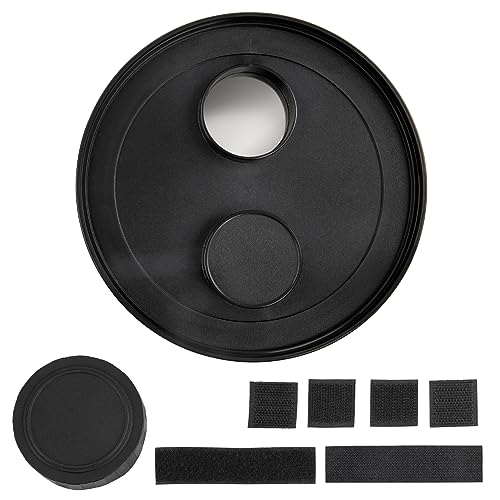
Some filters cover the whole opening (full aperture). Others put a smaller window of solar film in an opaque front cover: Celestron's filter for 127mm and 130mm reflectors has a 43mm clear aperture, and its 8-inch filter a 176mm clear aperture. A properly designed reduced-aperture front cover is still a front-mounted filter, and it is nothing like an unsafe eyepiece filter. Whatever the design, the rule is the same. The filter goes on the front, and nothing unfiltered gets in.
On standards: Celestron says its EclipSmart filters conform to ISO 12312-2, the standard for filters for direct viewing of the Sun. AAS notes that ISO 12312-2 does not apply to filters for optics, and says such filters may be considered safe as long as they meet ISO 12312-2's requirements for transmittance, uniformity of transmittance, and material and surface quality, are mounted securely over the front of the instrument, and are used according to the supplier's instructions. A maker's reputation alone is not enough; AAS's supplier list is a starting point, and each filter still has to meet those conditions.
- Front only. The filter must cover the front of the telescope, binoculars or camera lens, held on firmly enough that a bump or a gust cannot knock it off.
- Never use an eyepiece "sun" filter. Filters that thread into the eyepiece, sold with some cheap telescopes, sit where the sunlight is already concentrated. AAS calls them dangerous, and Celestron warns they can crack from the heat. Discard any you own.
- Cap the finder scope. Never look through a finder without a filter. Cap it, remove it or filter it like the main telescope (AAS).
- Never combine eclipse glasses with unfiltered optics. AAS calls looking through unfiltered optics while wearing eclipse glasses extremely dangerous.
- Inspect before every use. If the film or glass is scratched, punctured or torn, do not use it (AAS). Supervise children at the eyepiece.
- Only remove it during complete totality. Inside the path, remove the filter only during complete totality. Stop unfiltered optical viewing and securely reinstall it seconds before totality ends, before any bright sunlight reappears. (Celestron.) The AAS advice to put eclipse glasses back on when the bright Sun reappears is for your unaided eyes, not for a telescope or binoculars.
Film or glass?
Celestron's EclipSmart telescope filters use aluminized polyester film (Mylar), produced in the US by American Paper Optics. Seymour Solar sells both, as Hyperion film and Helios glass; it describes Helios as glass with a reflective coating on both sides, mounted in an aluminum cell.
- Film: light, and the low-cost choice. Celestron says its film gives the Sun an orange tint, a natural look for viewing and photos. Film needs gentle handling; check it for pinholes before each use.
- Glass: comes mounted in a metal cell (Seymour's is aluminum), and it costs more.
Either works when it comes from a reputable maker and fits properly. If you mainly want to see an eclipse or sunspots a few times a year, film is enough.
How to size a solar filter to your telescope
A filter has to fit snugly over the front of the tube, with no gap at the edges. There are two ways to get the size right:
- Buy one made for your model. Celestron lists the telescopes each EclipSmart filter fits (table below). This is the easiest route for a Celestron telescope.
- Measure the front of your tube. Measure the outside diameter of the front end, including any dew shield, in millimeters, and buy a filter whose stated range includes it. Seymour Solar sells its filters by tube diameter; its 5-inch Helios, for example, fits tubes from 4 5/8" (118mm) to 4 7/8" (124mm). Celestron suggests measuring your telescope's front end and comparing it with its spec charts, or asking its support team.
Do not go by the aperture number alone. A "130mm" reflector's tube is wider than 130mm, and refractors with dew shields are wider than their lens. Measure.
| Filter | Fits (maker's list) | How it attaches |
|---|---|---|
| EclipSmart for 127mm and 130mm reflectors | PowerSeeker 127EQ, Astro Fi 130, NexStar 130SLT, Omni XLT AZ 130, SkyProdigy 130, StarSense Explorer LT 127AZ and other listed models | Two hook-and-loop straps |
| EclipSmart Universal | Front outside diameter of 75mm to 100mm (telescopes, spotting scopes; cameras only within Celestron's restrictions) | Adjustable side panels and an elastic band |
| EclipSmart for AstroMaster 70 | AstroMaster 70AZ, 70EQ and LT 70AZ | Three safety screws |
| EclipSmart 6" | Celestron 6-inch Schmidt-Cassegrains | Two hook-and-loop straps |
| EclipSmart 8" | Celestron 8-inch Schmidt-Cassegrains and EdgeHD | Two hook-and-loop straps |
1. Celestron EclipSmart filter for 127mm and 130mm reflectors
This fits several Celestron beginner telescopes, including the PowerSeeker 127EQ (see our PowerSeeker 127EQ review) and the 130mm StarSense and NexStar models. It is a front cover with a 43mm window of solar film that straps over the front of the tube, with a cap to protect the film in storage. Celestron says it conforms to ISO 12312-2:2015.
2. Celestron EclipSmart Universal Solar Filter: for small refractors and spotting scopes
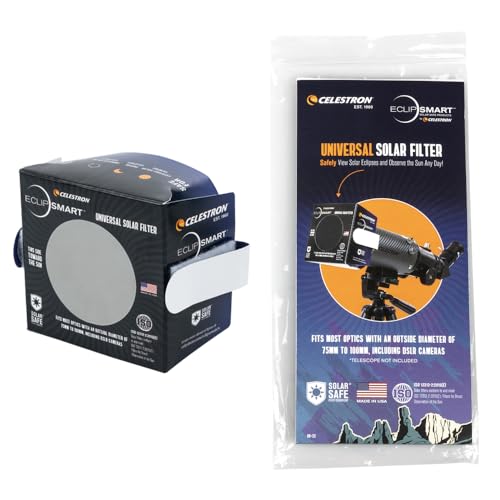
Celestron restricts camera use: never use this filter on a camera with an optical viewfinder (which rules out DSLRs), or if you are not sure what kind of viewfinder your camera has, and never point the camera and filter at the Sun for more than three continuous minutes. Always fit it directly on the front of the lens.
If your telescope is not on Celestron's model lists, this is the flexible option. You adjust its side panels to the front of the tube or lens and secure it with an elastic band, then fold it flat for storage. Measure first. It only fits fronts between 75mm and 100mm across, and the fit must be snug with no gap. Celestron also allows it on a camera lens in that range, but only within the camera limits in the note above.
3. Celestron EclipSmart filter for AstroMaster 70
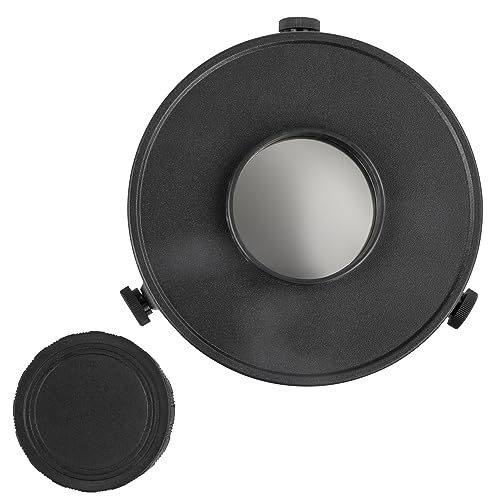
This filter is made for Celestron's AstroMaster 70 refractors. Three safety screws hold it securely in place when fitted according to Celestron's instructions. Celestron sells similar model-specific filters for other telescopes; check the compatibility list before ordering.
4. Celestron EclipSmart 8" (and 6") for Schmidt-Cassegrains

For a NexStar 8SE, an 8-inch EdgeHD or another Celestron 8-inch Schmidt-Cassegrain, this is the matching filter. The EclipSmart 6" filter does the same for Celestron 6-inch Schmidt-Cassegrains; it was also in stock and sold by Amazon.com on October 22, 2026. On a Schmidt-Cassegrain, also cap or filter the finder, which sits right next to the main tube.
5. Seymour Solar Helios glass: the glass option
If you want glass, Seymour Solar is on the AAS list and sells its own filters on Amazon US. The Helios glass filter clamps on with nylon thumb screws and felt tabs, and comes in sizes by tube diameter; the company also sells Hyperion film filters. Both were in stock and sold by Seymour Solar on October 22, 2026. Seymour describes them as ND5 white-light filters for front-mounted use. Pick the size whose stated range includes your measured tube diameter.
Solar filters for binoculars and cameras
Binoculars need a filter over each front lens, each held on securely. The simplest alternative is a pair of dedicated solar binoculars, which have the filters built in.
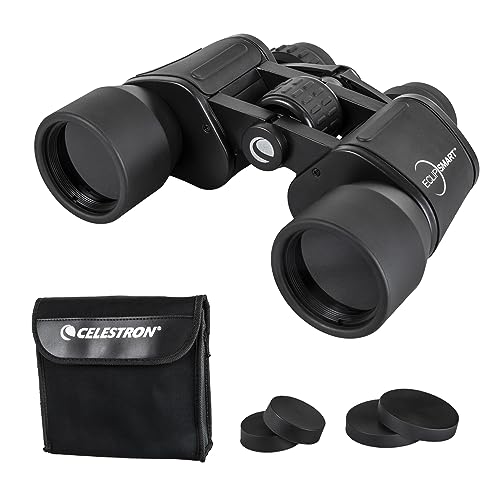
Celestron also sells a larger 12x50 and a compact 10x25; all three were in stock and sold by Amazon.com on October 22, 2026. There is one trade-off. Because the filters cannot be removed, solar binoculars show nothing during totality or at night, as AAS points out. Bring regular binoculars too if you will be inside the path.
Cameras need a solar filter over the front of the lens for every partial phase. The EclipSmart Universal above fits lenses with a front diameter of 75mm to 100mm, within Celestron's camera limits. It must never go on a camera with an optical viewfinder (so no DSLRs) or on one whose viewfinder type you are unsure of, and the camera and filter must not point at the Sun for more than three continuous minutes. For phones, AAS lists dedicated smartphone solar filters from makers such as Solar Snap and SafeShot. Never point an unfiltered camera, phone or lens at the Sun while looking through it.
What not to buy
- Eyepiece solar filters of any kind (see the safety rules above).
- Filters from sellers who do not name the maker. We left out several Amazon listings of loose solar film sheets on October 22 because the seller was not the maker and the listing did not name one. Check the brand against the AAS list.
- A filter that does not fit. A filter that is too large can slide or fall off; one that is too small leaves a gap. Measure first.
- Eclipse glasses or sunglasses as a telescope filter. Eclipse glasses are for your eyes only, never behind a telescope or binoculars, and ordinary sunglasses are not safe for looking at the Sun at all.
- A damaged filter. Scratches, pinholes or tears mean it goes in the bin.
If you make your own, use only Baader AstroSolar Safety Film 5.0 (never the Photo Film 3.8, which Baader says is not for visual observation) and follow Baader's complete instructions. For the next big chance to use one, see our guide to the total solar eclipse of August 2, 2027, and for night-time filters, how to use telescope filters.
Frequently asked questions
Can I look at the Sun through a telescope with a solar filter?
Yes, if the filter mounts securely over the front of the telescope, comes from a supplier on the AAS list, meets the conditions AAS sets for optics filters, fits snugly, is undamaged, and the finder scope is capped or filtered too. Never use a filter that screws into the eyepiece.
What is a solar filter?
A sheet of coated film or glass that blocks almost all of the Sun's light and heat before it enters a telescope, binoculars or camera, so you can safely see the Sun's disk and sunspots. For optics, it always mounts on the front.
Are eyepiece solar filters safe?
No. Filters that thread into the eyepiece sit where sunlight is already concentrated and can crack from the heat, exposing your eye to the full focused sunlight. AAS and Celestron both say not to use them; discard any you own.
Do I need a filter on my finder scope?
Yes, or keep it capped or removed. A finder scope is a small telescope in its own right and concentrates sunlight just like the main tube.
Can I use eclipse glasses with a telescope or binoculars?
No. Looking through unfiltered optics while wearing eclipse glasses is extremely dangerous, because the optics concentrate the light far beyond what the glasses can block. The filter has to go on the front of the instrument.
How do I know what size solar filter I need?
Buy one made for your telescope model, or measure the outside diameter of the front of the tube, including any dew shield, and choose a filter whose stated range includes that number. The fit should be snug with no gaps.
Can I take the filter off during a total eclipse?
Inside the path, remove the filter only during complete totality. Stop unfiltered optical viewing and securely reinstall it seconds before totality ends, before any bright sunlight reappears. During a partial eclipse, or anywhere outside the path, it stays on the whole time.
Sources
All checked October 22, 2026.
- American Astronomical Society: suppliers of safe solar viewers and filters (Celestron and Seymour Solar are listed for telescope, binocular and camera filters), using telescopes, binoculars and cameras safely, and eye safety.
- Celestron: What is a solar filter, and how do you use it? (ISO 12312-2 statement, film and glass, eyepiece filter warning, sizing).
- Seymour Solar (ND5, front-mounted filters).
- Amazon US product pages for each filter (compatibility, fit, seller and stock), read from a US address on October 22, 2026.