As an Amazon Associate, we earn from qualifying purchases. Check the exact model, seller, condition, delivery and current price before ordering.
You can pay a company to name a star or "buy a star," but the name has no official standing. The International Astronomical Union (IAU), the body that approves official star names, does not sell them, and astronomers do not use names bought from a star registry.
What you get is a keepsake, usually a certificate with the name you chose and a star chart showing roughly where the star sits. That can still be a sweet gift if both of you know what it is. If you want the person to see real stars, a gift that shows them the sky lasts longer.
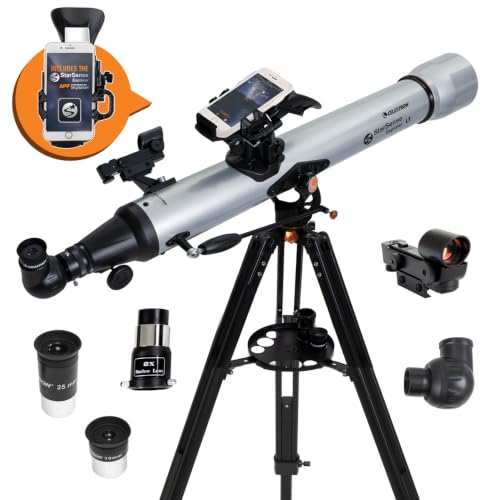
Our pick for a star gift is a phone-guided first telescope. Celestron's StarSense app uses the phone's camera to show where the tube points and guides you to what is up tonight.
Can you really buy or name a star?
No, not in any official sense. You can buy a certificate that gives a star a name, but no scientist, space agency or official catalog will use that name.
The IAU's own FAQ on buying stars and star names is direct about it. It says that "some commercial enterprises purport to offer such services for a fee," and that such names "have no formal or official validity whatsoever." It also says the IAU "dissociates itself entirely" from selling star names, and that any claim of an IAU link to these businesses is false.
The IAU's outreach office repeats the point on its Rules to Name a Star page. A personal dedication is "not recognized by astronomers or the IAU" and will not appear under that name in any scientific record. The Library of Congress also says it "has no connection with any star registry," and points readers to the IAU's statement.
So is buying a star real? The purchase is real, and so is the certificate. The name exists only in the seller's own records.
What you actually get when you buy a star
A typical name-a-star package is a printed certificate plus a star map that marks where the star is. Some sellers offer pricier packages with add-ons. Prices and packages vary by seller, and none of them changes the star's official status.
Radio astronomer Laura Nicole Driessen of the University of Sydney looked at these services for The Conversation in February 2026. She notes that their FAQs often say the names are kept in the company's own database. She also points out that some services claim hundreds of thousands of customers, far more than the roughly 2,500 stars you can see with the naked eye from one place under excellent dark skies. By her math, each of those stars has been named at least 20 times.
The IAU adds that there are several competing businesses around the world. Each company keeps the names in its own private database, so two companies can give the same star two different names.
None of that makes the gift worthless. It means you are buying a symbol and a nice piece of paper, not a place in an astronomy catalog.
Is naming a star worth it as a gift?
It is worth it when the symbol is the whole point and the person knows it. People buy these for anniversaries, a new baby, Valentine's Day, or in memory of someone they lost. A certificate on the wall that says "this star is for you" can mean a lot, and that is a fair reason to buy one.
It is a poor fit in three cases.
- The person thinks it is official. Finding out later that the name is not recognized can sour the gift. Say plainly that it is a symbolic gift.
- The person loves astronomy. Someone who knows the sky will know the name is not used, and may prefer a gift they can use outside.
- The star is hard to see. Only stars brighter than about magnitude 6.5 count as naked-eye stars, and town lights hide many of those. Check the star's magnitude before you buy, and whether it rises over the place where the person lives.
A middle path works well. If you still want the sentiment, pair the certificate with a planisphere or binoculars so the person can go outside and find the star themselves. The steps are below.
The IAU's FAQ makes a similar suggestion. For someone who loves the stars, it recommends a visit to a planetarium or an astronomy club, a night under a dark sky, or books and field guides. Our list of the best planetariums in the USA helps with the first idea.
How official star names work
Official star names come from the IAU's Working Group on Star Names (WGSN). It catalogs star names from cultures around the world and keeps a list of approved, unique proper names such as Sirius and Proxima Centauri. The IAU says it has formally recognized a few hundred proper names this way.
Most stars have no proper name at all. They carry a catalog designation made of letters and numbers. Vega, for example, is listed as HR 7001 in the Bright Star Catalogue. Designations like these make it possible to find one star among millions, which is why astronomers use them.
The public has had a real, free way to take part. In the IAU's NameExoWorlds contests in 2015, 2019 and 2022, people proposed names for some stars that host planets and for the planets themselves, and the IAU approved the winners. The IAU's outreach office says these public campaigns cover fainter stars, dimmer than magnitude 6.5, and that since 2022 the IAU has prohibited naming stars after individuals. It suggests asteroids or lunar craters, which follow different processes, as the place to honor people.
The IAU sums up its view in one line, that "the beauty of the night sky is not for sale." It is free for anyone to look at.
How to find your star in the sky
You can find the actual star with a free app or a planisphere, whether you bought a name or just want to point at a real star together. Here is the order that works.
- Find the star's address on the certificate or chart. Look for a catalog number (such as an HD, HIP or HR number), its coordinates (right ascension and declination), and the constellation it is in.
- Look it up in a free planetarium app. Stellarium Web runs free in a browser, and the desktop version of Stellarium is free too. The IAU's FAQ itself suggests planetarium software like Stellarium. Set your location, then type the catalog number into the search box. The app shows where the star is and when it rises and sets. Our guide to stargazing apps compares other options.
- Check that it is up at night. A star in a winter constellation such as Orion is hard to see on a summer evening. A planisphere shows at a glance which constellations are up on any date and hour.
- Go outside and let your eyes adjust. Give them at least 20 minutes away from screens and lights. Use a red light to read the planisphere or chart.
- Find the constellation, then hop to the star. Start from the brightest stars you recognize and follow the pattern on the chart. Our tutorial on reading star charts walks through it, and how to identify stars covers star hopping.
- Use binoculars if the star is faint. The IAU's outreach office counts stars brighter than magnitude 6.5 as naked-eye stars, and that takes a dark sky. Fainter stars, or dim stars seen from a bright town, need binoculars or a small telescope.
If the app says the star is fainter than about magnitude 6, plan on binoculars from the start. That makes binoculars a natural partner for a named-star gift.
Better star gifts that show the real sky
These gifts put the real sky in someone's hands. Each one was read on Amazon US on October 28, 2026, and each card names the seller we saw. They run from a first telescope down to a planisphere and a book, so there is something at every cost.
1. Celestron StarSense Explorer LT 80AZ: a first telescope that finds stars
This is the card at the top of the page. Celestron lists an 80mm aperture, a 900mm focal length, 25mm and 10mm eyepieces plus a 2x Barlow lens, and a total kit weight of 9.2 pounds. The StarSense app uses the phone's camera to work out where the tube points, lists what is visible tonight and shows arrows until the target is in view.
The mount moves by hand, so there are no motors or batteries to manage. It suits a gift for someone who would rather see the Moon's craters and Saturn's rings than a name on paper. Check that the recipient's phone is on Celestron's compatibility list before you wrap it. See the LT 80AZ on Amazon.
2. Sky-Watcher Heritage 130P: a tabletop telescope for teens and adults

The Heritage 130P puts a 130mm mirror with a 650mm focal length (f/5) in a collapsible tube on a base you push by hand, so there is nothing to power or align. It comes with 25mm and 10mm eyepieces (about 26x and 65x) and a red dot finder.
The bigger mirror gathers more light than the 80mm refractor above, which helps on star clusters and brighter galaxies. The base sits on a table or a low wall. For more choices, see our best telescopes for beginners, and for a child, our telescopes for kids by age.
3. Celestron SkyMaster 15x70 binoculars: for faint stars and the Milky Way

The SkyMaster 15x70 magnifies 15 times through two 70mm lenses. That shows the Moon's larger craters, Jupiter's moons as points of light and star clusters such as the Pleiades. It also reaches stars well below naked-eye limits, so it is the easiest way to see a faint "named" star.
At this size the binoculars get tiring to hold for long. They work best on a photo tripod with a binocular adapter. Our page on stargazing binoculars explains what binoculars show and when they beat a small telescope.
4. A planisphere: the gift that pairs with a star name
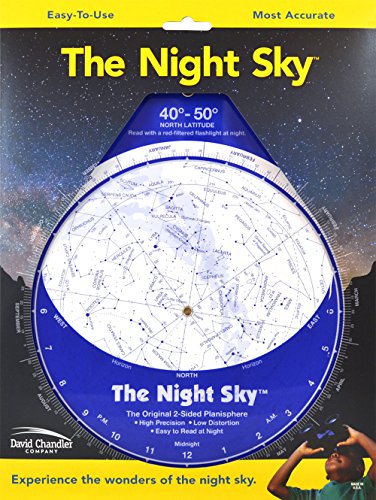
A planisphere is a rotating star chart. Set the date against the hour and it shows which constellations are above the horizon. David Chandler's version prints one side for looking north and one for looking south, which keeps the shapes less stretched than a single-sided wheel.
Pick the latitude band where the person lives. The 40° to 50° north version suits the northern US states and southern Canada. For the southern states, Chandler's 30° to 40° north version was also sold by Amazon.com on October 28, 2026. It needs no battery or signal, which makes it a good partner for a phone app.
5. Thames & Kosmos Planetarium Projector: a real star map on the ceiling
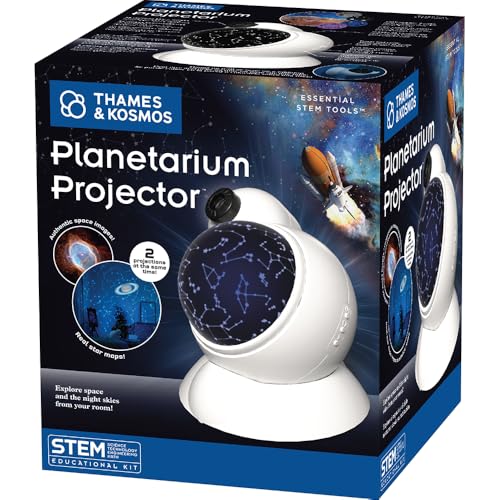
This kids' planetarium projector from the science-kit maker Thames & Kosmos has two projectors in one body. One casts a star map that rotates like the night sky, with maps for the northern and southern hemispheres. The other shows space pictures from image discs, such as planets, spacecraft and galaxies.
A nightlight mode switches it off after 15, 30 or 60 minutes. It suits a child who asks what a constellation is called, and on cloudy nights it keeps the real sky in view. Our star projector guide compares it with galaxy lights, whose stars are placed for effect and do not match the sky.
6. A constellation wall map: a star map print that shows the real sky

A star map print gives the wall-art feel of a certificate, but it shows the real stars and constellations. A constellation map like this one lets the person learn the patterns indoors and then match them outside.
Personalized prints that show the sky over a chosen place on a chosen night are another way to keep the sentiment. They make no claim to name anything; they just show the real sky on a date that matters. Before ordering one, check that the maker plots it from a real star catalog for the place and time you give.
7. Astronomy books: Turn Left at Orion and NightWatch
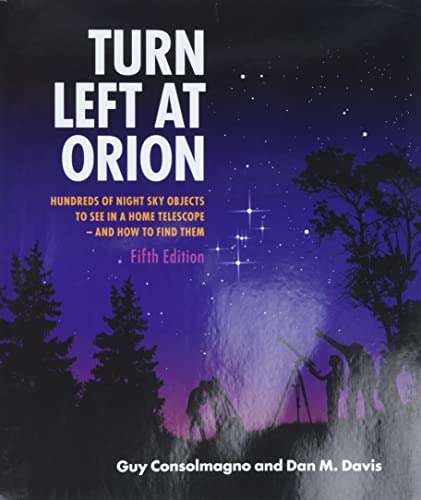
Guy Consolmagno and Dan Davis wrote Turn Left at Orion for people with a small telescope. Each target comes with a drawing of how it looks in the eyepiece and directions from bright stars. It pairs well with the two telescopes above.
For someone without a telescope, Terence Dickinson's NightWatch is a broader guide with star charts and equipment advice, also sold by Amazon.com on October 28, 2026. More ideas are in our astronomy books for beginners.
Which star gift fits who?
Match the gift to what the person will do with it. A certificate is something to keep; the others are things to use under the sky.
| If the person | Give | What they get |
|---|---|---|
| wants a keepsake for a special date | A named-star certificate, said plainly to be symbolic, plus a planisphere | The sentiment, and a way to find the star |
| is curious about the sky but owns nothing | Planisphere or NightWatch | The constellations, with no batteries or setup |
| wants to see a faint star or the Milky Way | SkyMaster 15x70 binoculars | Far more stars than the naked eye shows |
| wants to see the Moon and planets up close | StarSense Explorer LT 80AZ or Heritage 130P | Craters, Saturn's rings and Jupiter's moons |
| is a child, or the sky is often cloudy | Thames & Kosmos Planetarium Projector | A real star map on the bedroom ceiling |
| wants something for the wall | Constellation map or a real-sky print of a date | Real star positions instead of a made-up name |
For a wider list by budget, see our astronomy gift ideas.
Frequently asked questions
Is buying a star legit?
The sale is real, but the name has no official standing. The IAU, which approves official star names, says names sold by companies have no formal or official validity, and astronomers do not use them. You are buying a symbolic certificate and a star chart.
Can you name a star after someone officially?
Not through a purchase. Official star names are approved by the IAU's Working Group on Star Names, and since 2022 the IAU has prohibited naming stars after individuals. The IAU's NameExoWorlds contests let the public propose names for some stars that host planets.
Can you buy a star from NASA?
No organization sells official star names. Official names come from the IAU, and the IAU says the names it assigns are the ones used by scientists and space agencies. A name bought from any star registry is not one of them.
How much does it cost to name a star?
It depends on the seller and the package. No package at any price makes the name official, so compare what is in the box rather than the promise.
How do you look up a star you bought?
Take the catalog number or coordinates from your certificate or chart and search for them in a free planetarium app such as Stellarium. It shows where the star is and when it is up. Then use a planisphere to find its constellation outside, and binoculars if the star is faint.
Can two people name the same star?
Yes. Each company keeps its own list, and the IAU notes there are several competing businesses, so the same star can carry different names from different sellers. None of those names is official.
Is a named star a good gift?
It can be, as a clearly symbolic keepsake for an anniversary, a birth or a memorial. For someone who wants to see the sky, a planisphere, binoculars or a first telescope gives more use. You can also pair a certificate with a planisphere so the person can find the star.
The bottom line
Naming a star is a symbolic gift, not an official one. If the sentiment matters most, buy the certificate, say what it is, and add a planisphere so the person can find the real star. If you want them to fall for the sky itself, give them a way to see it. Try the StarSense Explorer LT 80AZ if they want to see planets, the SkyMaster 15x70 for faint stars, or a planisphere and a book to start tonight.