As an Amazon Associate, we earn from qualifying purchases. Check the exact model, seller, condition, delivery and current price before ordering.
- Quick picks
- What is the difference between planetarium projectors and galaxy lights?
- 1. Thames & Kosmos Planetarium Projector: best for learning constellations
- 2. Sega Toys Homestar Flux: best real home planetarium
- 3. Cloud b Twilight Turtle: best for a toddler's room
- 4. POCOCO Galaxy Star Projector: best galaxy projector with discs
- 5. Govee Galaxy Light Projector 2 Pro: best smart galaxy projector
- 6. Govee Star Light Projector with Nebula Effect: best mood light
- Which star projector fits who?
- How to choose a star projector
- From the ceiling to the real sky
- Frequently asked questions
A star projector throws points of light onto your ceiling so a dark room looks like a night sky. The models split into two groups. Planetarium-style projectors show real star maps with constellations you can learn. Galaxy or nebula lights wash the room in color with stars placed for effect rather than accuracy. Decide which one you want first, because a galaxy light will not teach anyone the Big Dipper.
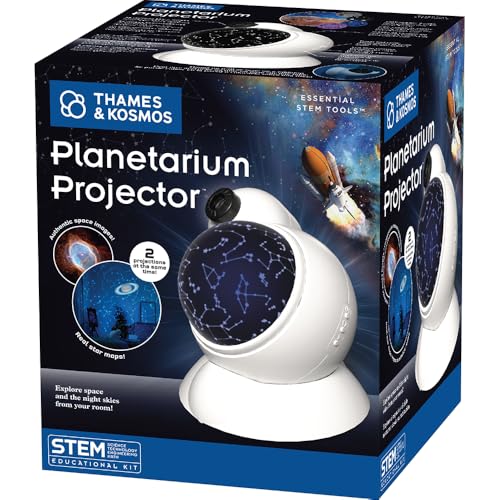
Our pick for kids is the Thames & Kosmos Planetarium Projector. It projects a rotating star map for both hemispheres, and it is the one projector here sold by Amazon.com.
Quick picks
- Best for learning constellations: Thames & Kosmos Planetarium Projector, a real star map for kids 8 and up.
- Best real home planetarium: Sega Toys Homestar Flux, for adults who want a convincing sky, sold on Amazon by a third-party seller.
- Best for a toddler's room: Cloud b Twilight Turtle, a plush night light with eight constellations in its stars.
- Best galaxy projector with discs: POCOCO Galaxy Star Projector, swappable film discs and a rechargeable battery.
- Best smart galaxy projector: Govee Galaxy Light Projector 2 Pro, eight discs and smart-home control.
- Best mood light for a bedroom or game room: Govee Star Light Projector with Nebula Effect, color zones and a built-in speaker.
What is the difference between planetarium projectors and galaxy lights?
The difference is whether the stars on your ceiling match the real sky. A planetarium-style projector shines light through a disc, dome or plate printed with an actual star map, so the Big Dipper, Orion and the other constellations appear where they belong. Some rotate slowly, the way the sky turns through the night.
A galaxy or nebula light mixes colored light into soft clouds and adds star points on top. In these lights the stars are decoration, placed for effect. That is fine for a mood light and useless for learning the sky.
Disc-based galaxy projectors sit in between. Brands like POCOCO and Govee sell film discs printed with images such as the Milky Way, nebulae, the Moon or planets. A disc can look striking, but unless the maker says it shows a mapped star field or named constellations, treat it as artwork.
| Projector | Type | Real constellations? | Best for | Sold by (Oct 27, 2026) |
|---|---|---|---|---|
| Thames & Kosmos Planetarium Projector | Planetarium, dual projector | Yes, rotating star map for both hemispheres | Kids 8+, learning the sky | Amazon.com |
| Sega Toys Homestar Flux | Planetarium, disc | Yes, on its star-field discs | Adults, home planetarium | Sivesco LLC (third party) |
| Cloud b Twilight Turtle | Night light | Eight constellations in the pattern | Toddlers and young kids | CloudB (maker's store) |
| POCOCO Galaxy Star Projector | Galaxy, film disc | Depends on the disc | Bedrooms, gifts for teens and adults | POCOCO Direct (maker's store) |
| Govee Galaxy Light Projector 2 Pro | Galaxy, film disc, smart | Depends on the disc | Smart-home rooms | Govee US (maker's store) |
| Govee Star Light Projector (Nebula) | Nebula light, smart | No | Mood lighting, game rooms | Govee US (maker's store) |
1. Thames & Kosmos Planetarium Projector: best for learning constellations
This is a real planetarium projector made for kids, from the science-kit maker Thames & Kosmos. It has two projectors in one body. One casts a star map that rotates to imitate the motion of the night sky, with maps for the northern and southern hemispheres. The other shows space pictures from image discs, such as planets, spacecraft and galaxies.
A nightlight mode turns the projector off on its own after 15, 30 or 60 minutes, and the maker rates it for ages 8 and up. It suits a child who already asks what a constellation is called, and it pairs well with a stargazing app for checking the same stars outside.
2. Sega Toys Homestar Flux: best real home planetarium

The Homestar line comes from Sega Toys. The Flux is the successor to the Homestar Original, and retailers and press describe it as the most powerful model in the line, with a 5-watt LED. Astroshop lists a 15, 30 or 60 minute timer and a focus range of about 1.4 to 2.7 meters.
It projects through swappable discs. This is our pick for an adult, a home theater or a dark bedroom. The older Homestar Original uses the same idea with a less powerful LED and was sold new by the same seller on October 27, 2026.
3. Cloud b Twilight Turtle: best for a toddler's room

The Twilight Turtle is a soft toy with a hard shell that projects stars onto the walls and ceiling. Cloud b places eight real constellations, including the Big Dipper, in its star pattern, with a star guide so a parent can point them out. The light comes in three colors, and Cloud b's retail listings give a 45-minute auto shut-off.
It is a night light first and a planetarium a distant second. It shows one star pattern, with no discs to swap. For a young child, that simplicity can be the point. When the same child is older and wants more, the Thames & Kosmos projector above is the natural next step.
4. POCOCO Galaxy Star Projector: best galaxy projector with discs

POCOCO's projector takes a film disc and throws a photo-like image onto the ceiling. POCOCO lists a 2-megapixel lens, a 30-degree tilt, a 15, 30 or 60 minute timer, disc rotation, and a choice of battery or plug power. Disc sets range from starry skies and constellations to the Milky Way and planets.
That makes it more flexible than a fixed galaxy light, and a good gift for a teen's or adult's bedroom. Just check which discs come in the box. A nebula photo is beautiful, but only a constellation disc helps anyone learn the sky.
5. Govee Galaxy Light Projector 2 Pro: best smart galaxy projector

Govee's 2 Pro is a disc projector built for a smart home. Govee lists a 4-megapixel lens, eight film discs in the box, more than 20 white noise options, a 90-degree projection angle, and control from the Govee Home app or through Matter, Amazon Alexa and Google Assistant. You can schedule it with other lights or start it by voice.
It is the most feature-heavy projector on this page and the one to choose if the room already runs on voice assistants. Like the POCOCO, it shows images rather than an accurate sky unless the disc says otherwise.
6. Govee Star Light Projector with Nebula Effect: best mood light

This is a galaxy light in the classic sense, with clouds of color and stars on top. Govee lists seven separate light zones, a built-in Bluetooth speaker, 18 white noise options, and Matter support for Alexa and Google Assistant.
Buy it for the look of a room, such as a game room, a teen's bedroom or a movie night. Do not buy it to teach constellations; its stars are not a map.
Which star projector fits who?
- Toddlers and preschoolers: a simple night light such as the Twilight Turtle. Soft light, a timer and nothing to set up.
- Kids 8 to 12 who like space: a real planetarium projector such as the Thames & Kosmos. They can find the same constellations outside on the next clear night. Our stargazing with kids tips cover that first night out.
- Teens and adults who want atmosphere: a disc galaxy projector (POCOCO or Govee 2 Pro), or a nebula light if the goal is pure color.
- Adults who want a convincing sky: the Homestar Flux, in a room you can make fully dark.
How to choose a star projector
- Decide between learning and mood. If constellations matter, look for the words star map, planetarium or named constellations in the maker's description. "Galaxy" and "nebula" usually mean decorative stars.
- Look at the discs. Disc projectors are only as accurate as the disc. Check what is in the box and whether more discs are sold.
- Plan for darkness. Every projector here looks best in a fully dark room. Streetlights through thin curtains wash out the faint stars first.
- Check the timer and power. An auto-off timer matters in a child's room. A battery lets you move the projector between rooms; a plug means you never have to charge it.
- Treat "4K" and "5K" disc labels with care. They are each brand's own description of disc detail, not a standard you can compare across brands.
- Check the seller. Several projectors here are sold by the maker's own store rather than Amazon.com, and listings change. Confirm the seller and condition on the product page before you order.
From the ceiling to the real sky
A projector is a good way to learn the shapes, and the real sky is where they pay off. Once a child can find the Big Dipper on the ceiling, take them outside to find it on a clear night, then try a telescope for kids on the Moon. If you want the full dome experience, our list of the best planetariums in the USA covers the big public theaters. For more gift ideas, see our astronomy gift guide.
Frequently asked questions
What is a star projector?
A star projector is a lamp that shines points of light onto a ceiling or wall so a room looks like a night sky. Planetarium-style models show a real star map with constellations; galaxy and nebula lights add colored clouds and decorative stars.
What is the difference between a star projector and a planetarium projector?
Planetarium projector usually means a star projector that shows an accurate star map, like the Thames & Kosmos Planetarium Projector or the Sega Toys Homestar. Many products sold as star projectors are galaxy lights whose stars do not match the real sky.
Are galaxy projectors worth it?
For mood lighting in a bedroom or game room, yes, if you like the look. For learning constellations, no. Choose a planetarium-style projector or a disc that the maker says shows a mapped star field.
Which star projector is best for a kid's bedroom?
For toddlers, a simple night light such as the Cloud b Twilight Turtle, which turns off after about 45 minutes. For kids 8 and up who like space, the Thames & Kosmos Planetarium Projector, which has a rotating star map and a nightlight timer.
Do star projectors show real constellations?
Only some. Planetarium-style projectors and constellation discs show real star patterns; most galaxy and nebula lights place stars for effect. Check the maker's description for a star map or named constellations.
How much does a planetarium projector cost?
Home planetarium projectors run from kids' science kits to enthusiast models like the Sega Toys Homestar, and Amazon offers change often, so check the current price on each product page. The domed projectors used in public planetariums are professional equipment in a different class.