As an Amazon Associate, we earn from qualifying purchases. Check the exact model, condition, delivery and current price before ordering.
- How a telescope works, step by step
- What the lens or mirror does: gathering light
- What the eyepiece does: magnification
- How a refracting telescope works
- How a reflecting telescope works
- How compound (catadioptric) telescopes work
- Why the image is upside down
- How space and radio telescopes work
- The mount: pointing and tracking
- Which type should a beginner start with?
- Frequently asked questions
A telescope works in two steps. First, a large lens or mirror (the objective) collects far more light than your eye and focuses it into a small, bright image. Second, a small lens (the eyepiece) magnifies that image for your eye. The bigger the objective, the fainter and finer the details you can see; the eyepiece decides how large they look.
Everything else, from the tube to the mount, exists to hold those two parts in line and point them at the sky.
How a telescope works, step by step
- Light arrives. Light from a star or planet reaches Earth as almost perfectly parallel rays, because the object is so far away.
- The objective gathers it. A lens bends the rays, or a curved mirror reflects them, so they all meet at one point, the focus. The distance from the objective to the focus is the focal length.
- An image forms. At the focus, the light makes a small, real image of the object, upside down. You could catch it on a piece of paper, which is exactly where a camera sensor goes.
- The eyepiece magnifies. The eyepiece works like a magnifying glass held up to that image, enlarging it and sending the light into your eye.
- The mount points and follows. The mount holds the tube steady and lets you move it, by hand, with slow-motion knobs or with motors that track the sky.
Refractor: a lens bends the light to a focus
Newtonian reflector: a mirror reflects the light to a focus
What the lens or mirror does: gathering light
The objective's width, called aperture, is the most important number on any telescope. Light grasp grows with the area of the opening, so it rises with the square of the width. A dark-adapted eye has a pupil of about 7mm; a 130mm telescope collects roughly 345 times more light, which is the figure Celestron lists for its 130mm models. That is why faint galaxies and nebulae, invisible to the eye, appear in a telescope.
Aperture also sets how fine a detail the telescope can split. A common estimate, Dawes' limit, is 116 divided by the aperture in millimeters, in arcseconds: about 0.9 arcseconds for a 127mm telescope, matching Celestron's published figure. More aperture means sharper detail on planets and closer double stars, when the air is steady. See what is a good aperture for a telescope.
What the eyepiece does: magnification
Magnification is the telescope's focal length divided by the eyepiece's focal length. A 650mm telescope with a 25mm eyepiece gives 26x; swap to a 10mm and you get 65x. A Barlow lens multiplies the result. Magnification only enlarges what the objective delivers, so a common rule of thumb caps useful power at about twice the aperture in millimeters, and the air often sets a lower practical limit. Our telescope magnification guide explains how to calculate magnification.
How a refracting telescope works
A refractor uses a glass lens at the front of a closed tube. The lens bends incoming light toward a focus at the back, where the eyepiece sits. Galileo turned a refractor to the sky in 1609. A single lens bends each color by a slightly different amount, which leaves colored fringes around bright objects, so modern refractors use two or three lens elements (achromatic or apochromatic designs) to bring the colors back together.
Refractors need little maintenance and give crisp, high-contrast views, but large lenses are heavy and expensive, so most amateur refractors stay at 60mm to 120mm. See our best refractor telescopes for current models.
How a reflecting telescope works
A reflector uses a curved mirror at the bottom of an open tube. In the Newtonian design that Isaac Newton built in 1668, the primary mirror reflects light back up the tube to a small flat mirror set at an angle, which sends it out the side to the eyepiece. Mirrors reflect every color the same way, so there is no color fringing, and large mirrors cost far less than large lenses. That is why the biggest amateur and professional telescopes are reflectors.
The trade-off is upkeep: the two mirrors need lining up (collimation) from time to time, and the best primary mirrors are parabolic rather than spherical. A Dobsonian is a Newtonian reflector on a simple swivel base. Compare the two families in refractor vs reflector.
How compound (catadioptric) telescopes work
Schmidt-Cassegrain and Maksutov-Cassegrain telescopes combine both ideas: a corrector at the front plus two mirrors that fold the light path back and forth, so a long focal length fits in a short tube. That makes them compact and well suited to planets and imaging. Our Schmidt-Cassegrain vs Dobsonian guide explains the trade-offs, and types of telescopes covers every design.
Why the image is upside down
The objective forms an inverted image, and an astronomical eyepiece does not turn it back, because extra glass would cost light and sharpness and there is no up or down in space. Refractors and Schmidt-Cassegrains are usually used with a star diagonal, which turns the view right side up but mirror-reversed. Spotting scopes and some beginner eyepieces add an erecting prism or lens for daytime use.
How space and radio telescopes work
The same principle scales up. The Hubble Space Telescope is a reflector with a 2.4-meter primary mirror, above the blurring of Earth's atmosphere. The James Webb Space Telescope uses a 6.5-meter mirror made of 18 hexagonal segments and observes mostly in infrared light. A radio telescope is a giant dish that reflects radio waves onto a receiver at its focus; computers turn the signals into images. You can even build a simple radio telescope at home.
The mount: pointing and tracking
A telescope is only as good as what holds it. An alt-azimuth mount moves up and down and left and right, like a camera tripod head. An equatorial mount tilts one axis toward the celestial pole, so turning a single axis follows the stars as Earth rotates. Computerized (GoTo) and phone-guided mounts help you find objects; see alt-az vs equatorial mounts.
Which type should a beginner start with?
For most beginners, a 114mm to 150mm reflector gives the most light for the money, and a 70mm to 102mm refractor is the easiest to carry and maintain. If finding objects worries you, a phone-guided model shows where to point.
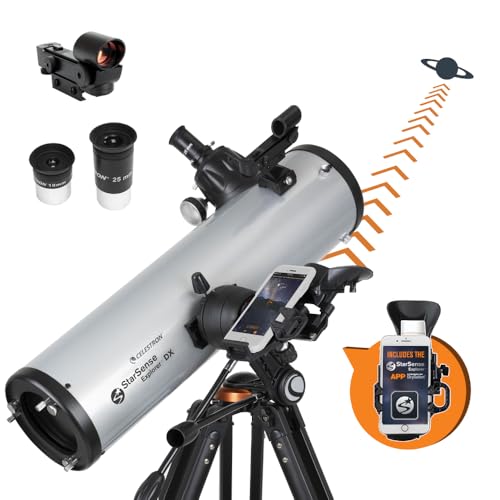
For more choices by budget, see the best telescopes for beginners.
Frequently asked questions
Does a telescope magnify or collect light?
Both, but collecting light matters more. The lens or mirror gathers light to show faint objects and fine detail; the eyepiece then magnifies the image. Magnification without enough aperture only shows a bigger blur.
Why do large telescopes use mirrors instead of lenses?
Big lenses are heavy, can sag because they are held only at the edge, and spread colors apart. Mirrors can be supported from behind, reflect all colors equally, and cost far less at large sizes.
What type of telescope did Isaac Newton invent?
Newton built the first practical reflecting telescope in 1668. Its design, a curved primary mirror with a small flat mirror sending light to the side, is still called a Newtonian.
Can a telescope see planets?
Yes. Even a small telescope shows Jupiter's moons and cloud belts, Saturn's rings and the phases of Venus. Larger apertures show more detail on steady nights.