As an Amazon Associate, we earn from qualifying purchases. Check the exact model, condition, delivery and current price before ordering.
- Quick picks
- 1. Celestron X-Cel LX 2x: best overall
- 2. Celestron Omni 2x: best value
- 3. Celestron X-Cel LX 3x: for short focal length telescopes
- 4. Celestron Luminos 2.5x: for 2-inch focusers
- 2x or 3x: which Barlow for your telescope?
- Plan your eyepieces around the Barlow
- Does a Barlow lens reduce image quality?
- Frequently asked questions
A Barlow lens slides into your focuser in front of the eyepiece and multiplies its magnification, usually by 2x or 3x. One good Barlow can double the eyepieces you own. A poor one dims and softens the view, so the glass matters more than the number on the barrel.
Our pick: the Celestron X-Cel LX 2x Barlow, a three-element design that works with any 1.25-inch eyepiece. On a tight budget, the Celestron Omni 2x does the same job with simpler optics.

Quick picks
- Best overall: Celestron X-Cel LX 2x Barlow (three elements).
- Best value: Celestron Omni 2x Barlow (two elements, very light).
- For short focal length telescopes: Celestron X-Cel LX 3x Barlow.
- For 2-inch focusers: Celestron Luminos 2.5x Barlow (takes 1.25" and 2" eyepieces).
1. Celestron X-Cel LX 2x: best overall
The X-Cel LX 2x uses three lens elements in two groups (Celestron's specification), fully multi-coated, in a 1.25-inch barrel with filter threads. Celestron describes the X-Cel LX Barlow's optics as apochromatic and fully multi-coated. It weighs about 150 g (Celestron's figure); check balance with the eyepiece fitted.
Choose it if you already own two or three decent eyepieces and want to double them without buying more. It is the one we would put in any 1.25-inch focuser, from a 70mm refractor to an 8-inch Dobsonian.
2. Celestron Omni 2x: best value

The Omni is Celestron's basic 2x Barlow: two elements, fully multi-coated optics with blackened lens edges, 60 g, and filter threads. Its simpler two-element design is the main difference from the X-Cel LX.
It is the right choice if you are not sure yet how much you will use a Barlow, or if your telescope is small and light.
3. Celestron X-Cel LX 3x: for short focal length telescopes
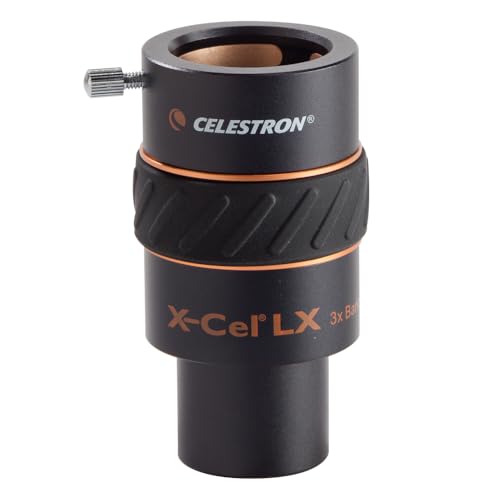
A 3x Barlow makes sense on telescopes with a short focal length, such as a 130mm f/5 reflector (650mm) or a short refractor, where even a 6mm eyepiece only reaches about 108x. On those, a 10mm eyepiece with the 3x gives 195x for the Moon and planets on steady nights.
On a long telescope it is usually too much: a 1200mm Dobsonian with a 10mm eyepiece and a 3x Barlow gives 360x, close to the rule-of-thumb ceiling for an 8-inch and rarely usable. There, a 2x is the better tool.
4. Celestron Luminos 2.5x: for 2-inch focusers
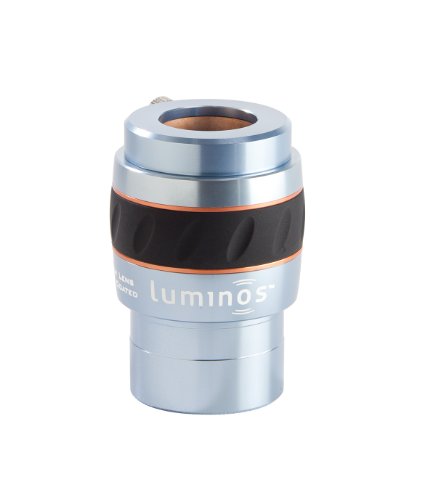
The Luminos has a 2-inch barrel and four elements, and it accepts both 2-inch and 1.25-inch eyepieces. That suits 8-inch and larger Dobsonians and SCTs with a 2-inch focuser or diagonal. Check your focuser first: it will not fit a telescope that only takes 1.25-inch accessories, which covers most beginner telescopes.
2x or 3x: which Barlow for your telescope?
Magnification is your telescope's focal length divided by the eyepiece's focal length, then multiplied by the Barlow. Under ideal conditions, a common rule of thumb puts the ceiling at about twice your aperture in millimeters; how much you can really use depends on the night's air and is often lower. Here is what a common 10mm eyepiece gives:
| Telescope | 10mm alone | With 2x | With 3x | Better choice |
|---|---|---|---|---|
| 70mm refractor, 400mm | 40x | 80x | 120x | 3x |
| 130mm reflector, 650mm | 65x | 130x | 195x | 3x or 2x |
| 114mm or 127mm, 1000mm | 100x | 200x | 300x | 2x |
| 8-inch Dobsonian, 1200mm | 120x | 240x | 360x | 2x |
| 8-inch SCT, 2032mm | 203x | 406x | 610x | Use it with a long eyepiece |
On long telescopes, use the Barlow with your low-power eyepieces (a 25mm or 32mm), not your shortest one.
Plan your eyepieces around the Barlow
A 2x Barlow turns a 20mm into a 10mm and a 12mm into a 6mm. If you already own a 20mm and a 10mm, a 2x Barlow repeats the 10mm. Pick eyepieces whose Barlowed powers land between the ones you have; for example 25mm and 15mm with a 2x Barlow give four different powers (25, 15, 12.5 and 7.5mm equivalents). Our Barlow lens vs eyepiece guide walks through when a Barlow beats buying another eyepiece, and the eyepiece kits guide lists sets that come with a Barlow.
Does a Barlow lens reduce image quality?
A good multi-coated Barlow loses very little light or sharpness, and it can make short-focus telescopes easier to use by giving more eye relief than a very short eyepiece. Cheap single-element or plastic Barlows are where problems start: dimmer views, color fringes and internal reflections. The image also gets dimmer simply because the magnification goes up, the same as with any higher-power eyepiece.
Premium amplifiers such as Tele Vue's Powermates go a step further; see Powermate vs Barlow. If you want the theory, read how Barlow lenses work.
Frequently asked questions
Does a Barlow lens increase magnification?
Yes. A 2x Barlow doubles the magnification of any eyepiece you put in it, and a 3x triples it. A 20mm eyepiece behaves like a 10mm with a 2x Barlow.
Is a 2x or 3x Barlow better?
A 2x suits most telescopes with focal lengths of 900mm and longer. A 3x makes sense on short telescopes (about 400mm to 650mm) where your shortest eyepiece still gives too little power.
Can you use a Barlow lens with any eyepiece?
Any eyepiece with the same barrel size. A 1.25-inch Barlow takes 1.25-inch eyepieces; a 2-inch Barlow like the Luminos 2.5x needs a 2-inch focuser but accepts both sizes.
What is the best Barlow lens for doubling magnification?
For most telescopes, a three-element 2x such as the Celestron X-Cel LX 2x. On a budget, the Celestron Omni 2x is a solid two-element option.