Start with duration and behavior, then verify the time and direction. One bright point or one long-exposure streak is rarely enough to identify an object confidently.
The chart below is a field aid, not a certainty detector. Aircraft, satellites, meteors and other events can overlap in appearance, especially in a compressed phone video.
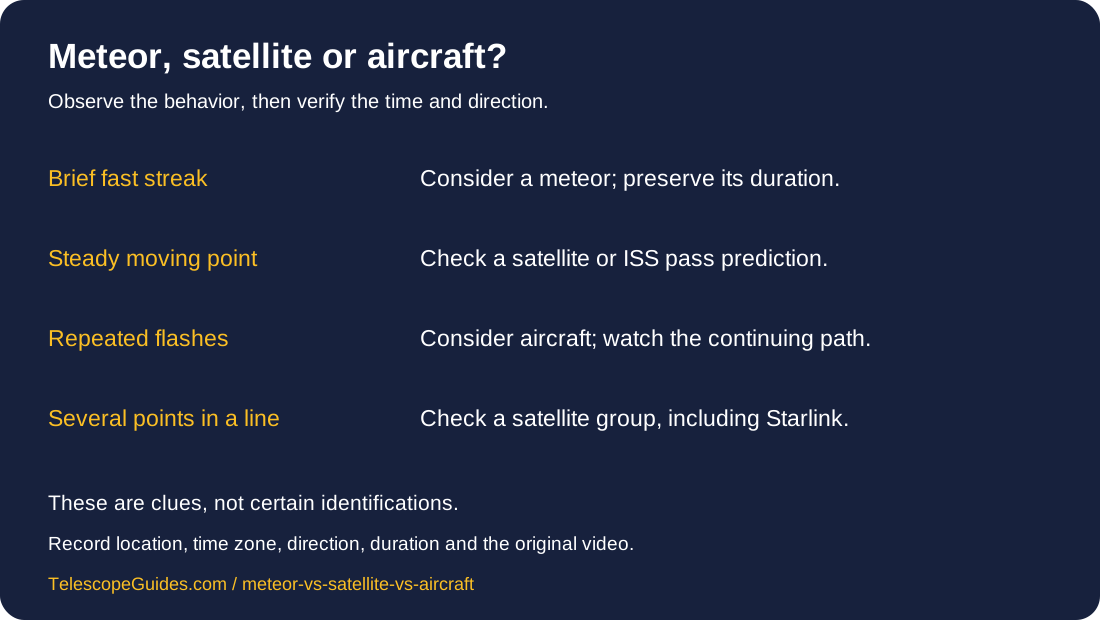
A quick identification chart
| Observation | More consistent with | What to check next |
|---|---|---|
| Brief fast streak that appears and ends | Meteor | Duration, direction and other witness reports |
| Steady point moving across the sky for minutes | Satellite or ISS | A pass prediction for that exact time and location |
| Repeated flashes, sometimes colored | Aircraft | A continuing route and any audible engine noise |
| Several points following a similar path | A satellite group, possibly a recent Starlink deployment | Current orbit predictions rather than a generic launch headline |
| Bright object apparently stationary | Star, planet, or a distant approaching aircraft | Watch its position against fixed surroundings over time |
| Long bright event with multiple fragments | Possible reentry or bright fireball | Preserve the recording and avoid an instant classification |
This original comparison is based on the observing distinctions explained below. You may share the chart with a credit and link to TelescopeGuides; keep the uncertainty column with it.
What a meteor is
A meteor is the luminous event produced when material enters the atmosphere. It is not a star falling out of the sky. NASA's meteor and meteorite overview explains the terminology; our shooting-star guide develops it for observers.
Do not use an absolute one-second cutoff. Some bright events last longer, and the way a camera records or plays a clip can distort your impression of duration. Record what you saw before choosing a label.
Why a satellite can disappear abruptly
A satellite can remain visible while illuminated by the Sun even when your observing location is dark. It may fade as the geometry changes or disappear into Earth's shadow. That is one reason an apparently steady light can vanish without having exploded or landed.
NASA's Spot the Station guidance provides a way to check ISS passes. Use your actual location, date, time zone and direction; matching only the approximate hour is weak evidence.
How aircraft confuse the picture
An aircraft coming roughly toward you can appear nearly stationary before its movement becomes obvious. Its lights may be difficult to distinguish at a distance. Repeated flashes are a clue, but absence of audible sound does not prove it is a satellite.
Watch against a fixed reference such as a rooftop and note whether the track persists. Do not chase an object across roads or restricted property to improve the recording.
A useful observation record
Write down local date, precise time and time zone, location, direction, approximate height above the horizon, duration, color and whether the light blinked. Keep the original video rather than only a cropped social-media copy. Note whether it was visible to your eyes as well as the camera.
For a photo sequence, check neighboring frames. A trail that continues along the same route across multiple frames is different evidence from one streak confined to a single frame. A single long exposure can hide the timing information needed to tell them apart.
Confirm before naming it
Use satellite tracking tools for a prediction, then compare path and timing. For a row of lights, read Starlink train vs ISS. For photographing an actual shower, use the iPhone meteor guide.
If several possibilities remain, call it an unidentified moving light and retain the evidence. That is a more accurate description than confidently naming a satellite from a few blurry pixels.
Frequently asked questions
Do satellites blink?
Their brightness can vary with orientation and illumination. A pattern of aircraft-style flashes is useful evidence, but no single brightness behavior identifies every object.
Is every line of lights Starlink?
No. It is a possibility to check against current predictions, not a diagnosis from shape alone.
Can one photograph prove it was a meteor?
Sometimes a photograph is persuasive, but time, direction, neighboring frames and independent observations make the identification stronger.