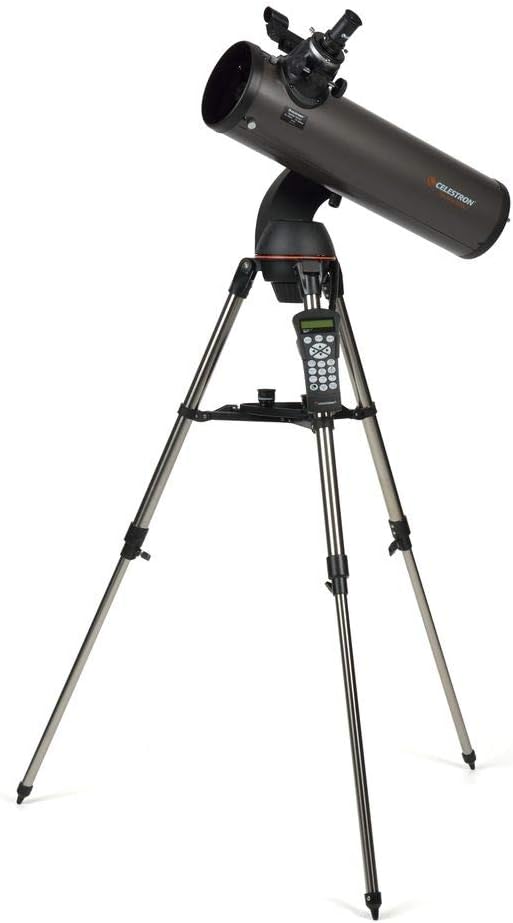
- Any telescope can show Andromeda - even a 50mm refractor reveals its bright core; larger apertures reveal more structure.
- Low magnification is key - Andromeda spans 3° on the sky (6x the full Moon), so wide-field views work best.
- Dark skies matter more than aperture - light pollution is the biggest obstacle to seeing Andromeda's outer regions.
- An 8-inch telescope gives the most satisfying views, revealing the bright core, companion galaxies M32 and M110.
The Andromeda Galaxy (M31) is one of the most spectacular targets for backyard astronomers. At 2.5 million light-years away, it's the farthest object visible to the naked eye - and even a modest telescope reveals stunning detail. But how good of a telescope do you actually need?
Can I observe Andromeda through a normal telescope?
You can observe Andromeda through a normal telescope. Although the Andromeda galaxy is very far from the earth, it’s large and bright enough to be seen with the naked eye and telescopes in areas with no light pollution.
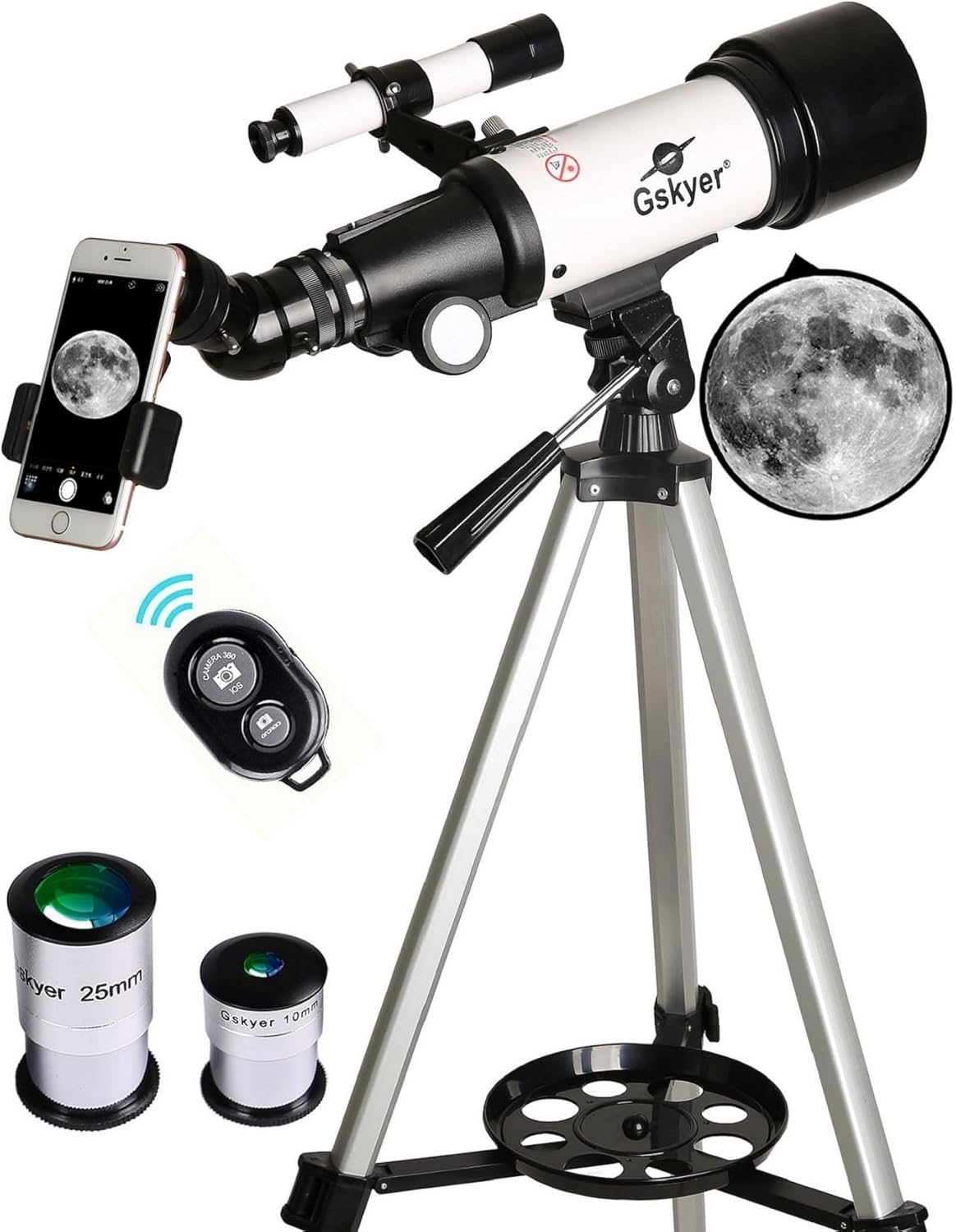
If normal telescopes are the ones you can buy on Amazon and set up in your backyard or easily transport from point A to B, the answer is still “yes.” Your Meade and Celestron telescopes and other consumer telescopes will show you M31.
A normal telescope will enhance your view and help you see extra details, such as the core and spiral arms.
What type of telescope is required to view the Andromeda galaxy?
To view the Andromeda galaxy, you need a telescope with a short focal length and a wide field of view. Additionally, the telescope should have sufficient aperture size for good contrast but nothing with too much magnification to see the Andromeda galaxy in its entirety.
The features and characteristics of the night sky object you want to see will determine the type of telescope you’ll need.
A telescope with a long focal length and resultant narrow field of view is great for planetary observations. On the other hand, a telescope with a short focal length and wide angle of view is better for viewing large deep sky objects.
Telescope features for observing Andromeda in the night sky
The Milky Way and the Andromeda galaxy are the largest galaxies in the earth’s “local group.” Andromeda contains approximately one trillion stars, while the Milky Way contains about 250 billion stars. This data shows how expansive the Andromeda galaxy is.
To capture the Andromeda galaxy with as many details as possible, you must prioritize features such as aperture size, focal length, focal ratio, and magnification. Other factors you may consider include the telescope’s portability and price range.
Here is a detailed explanation of the features.
Aperture size
Most of the Andromeda galaxy is faint and fuzzy except for its bright core. A telescope with a large aperture size will collect more light and make the faint and fuzzy parts of the galaxy brighter. Hence, you’ll see more details, such as the dark dust lanes and outer arms.
However, a telescope with a small aperture size will not be able to resolve the faint and fuzzy parts, and Andromeda will appear marginally bigger than a few stars.
But there’s a tradeoff as you increase the aperture size. As aperture size increases, your field of view decreases.
While you’ll see more details with a greater aperture size, your field of view will be narrow. Hence, you won’t be able to see all of it at once.
This setup may not be a problem if you’re merely observing the night sky object. But if you’re trying to capture an image, you must balance having a good-enough aperture size and a wide field of view.
That is, you also have to consider the focal length, focal ratio, and magnification of the telescope, as you’ll see below.
Focal length
Telescopes with shorter focal lengths have a wider field of view and are more suitable for larger deep sky objects and galaxies like the Andromeda galaxy. Telescopes with long focal lengths are more suitable for observing the moon and the planets.
The focal length of any telescope affects two major things, the magnification and the field of view. The longer the focal length, the higher the magnification and the narrower the field of view.
The focal ratio for deep sky objects
You’d need a telescope with a focal ratio of f/7 or below to observe the Andromeda galaxy. These types of telescopes are referred to as “fast” telescopes. Such telescopes will provide lower magnification but a wider field of view to see more of the night sky.
You can calculate the focal ratio of a telescope by dividing its focal length by the aperture size. Ensure that both measurements are in the same units, inches, or millimeters.
So if you have a telescope with an aperture size of 8 inches and an 80-inch focal length, its focal ratio is f/10 (800/8). An 8-inch aperture size telescope with a focal length of 16 inches focal length has a focal ratio of f/2.
While the two telescopes have the same aperture size and light-collecting ability, the f/2 telescope (typically called an astrograph) will produce a brighter image of the targeted object.
For astrophotography purposes, the focal ratio also determines the exposure times.
The Sky-Watcher Classic 200 Dobsonian 8-inch Aperture Telescope, which combines a large aperture size with a short focal ratio of f/5.9, is perfect for viewing the Andromeda galaxy.
Magnification
To study the Andromeda galaxy, a telescope with magnification between 80x and 150x should suffice. You can calculate magnification by dividing the focal length of your telescope by the focal length of the eyepiece you’ll observe with.
While having a good telescope with substantial theoretical magnification is great, it is not a requirement for watching gigantic deep sky objects like the Andromeda galaxy.
So if you have a telescope with a 500mm focal length and an eyepiece with a 5mm focal length, the magnification is 100X (500/5).
Portability
Observing the Andromeda galaxy requires a dark sky site away from the light pollution of urban cities. This means you may have to travel with your telescope. For this reason, you want to purchase a lightweight telescope that is equally easy to set up and dismantle.
The Celestron Inspire 100AZ Refractor is a portable and lightweight (only 20 pounds) option you can carry to dark sky sites to observe deep sky objects. It is also perfect for newbie astrophotographers.
Price range
As aperture size increases, so do the weight and price of telescopes, in most cases. How big you can go will depend on your budget or how far you can stretch to get the combination of qualities required to observe Andromeda.
That said, ensure that you consider your long-term interests when purchasing any new telescopes. Consider other factors such as durability and high mechanical quality.
We recommend the Celestron Astro Fi 130 Wireless Reflecting Telescope as a telescope you can use to view Andromeda. It is great for planetary and deep sky observations. It won’t also dig a big hole in your pocket.
If money is no objection, the Unistellar eVscope 2 Digital Telescope is the ultimate device for astronomical imaging.
How to find the Andromeda galaxy?
The Andromeda galaxy is located in the constellation Andromeda. Whether you’re viewing from the northern hemisphere or otherwise, August to October is the best period to observe M31, with the galaxy rising in the eastern sky in the early parts of October.
Please note that when observing the Andromeda galaxy, it’ll not look like most of the pictures you see online. These pictures are a result of stacking together several long-exposure images.
To find and observe the Andromeda galaxy, follow the steps below.
1. Find a dark-sky location away from city lights and light pollution
Dark skies are essential when observing the Andromeda galaxy. If you attempt to view M31 in areas with high light pollution, you’ll only be able to see the bright core of this solar system object.
Away from city lights and light pollution, you may even observe the galaxy in the night sky without any optical tool. If you don’t see it or if you want to observe it in more detail, you must “star hop.”
Also, ensure you’re observing the Andromeda galaxy on a moonless night. You don’t want the moon’s brightness to interfere with the details you can see.
2. Look for the constellation Cassiopeia, shaped like a “W” or “M” in the northern sky

The constellation Cassiopeia is perhaps the easiest route to the Andromeda constellation. As you can see from the image above, Andromeda is close to Cassiopeia.
Cassiopeia is regarded as a circumpolar constellation, meaning you can see it all night long, and it’s easy to track.
When you look towards the northeast, Cassiopeia is recognizable by the arrangement of its five brightest stars. Depending on your location, these stars form a ‘W’ or ‘M’ pattern.
3. Locate the bright star called “Alpha Cassiopeiae”

Alpha Cassiopeia, also called Schedar, is the brightest star in the Cassiopeia constellation. It has a visual magnitude of 2.23, which makes it easy to observe. Schedar is the point marked by the red circle.
The angle Schedar makes with beta Cassiopeiae, and gamma Cassiopeiae points towards the Andromeda constellation.
4. Use Alpha Cassiopeiae as a guide to locate Mirach
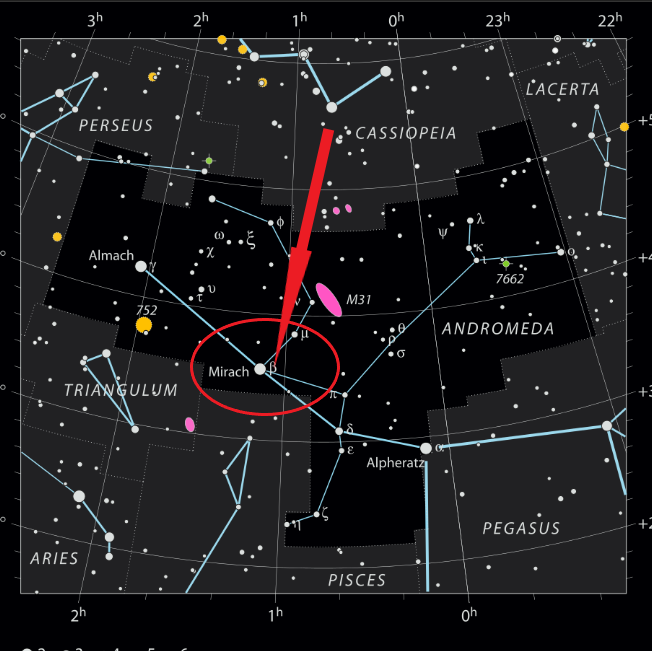
Mirach, alongside Alpheratz, are the two brightest stars in the Andromeda galaxy. The two stars have a visual magnitude of 2.06 and are easy to spot. Mirach is a few degrees southwest of Schedar.
5. Locate Andromeda galaxy with Mirach
After locating Mirach, you can easily find the Andromeda galaxy. M31 is about 8° northwest of Mirach.
Using a telescope with a wide field of view may also show you some of Andromeda’s satellite galaxies, like M110, the largest and brightest of the lot.
In the northern hemisphere, the Andromeda galaxy is perhaps the brightest galaxy you can observe. It’s a breathtaking view and a sufficient challenge for astrophotography newbies.
You need a telescope with good light-collecting capabilities and a short focal ratio to see it in its full glory. These twin features will provide adequate brightness and a wide field of view to capture the entire galaxy.