As an Amazon Associate, we earn from qualifying purchases. Check the exact model, condition, delivery and current price before ordering.
The finder that ships with many Dobsonians is a small red dot or a 6x30 straight-through scope, and on a big, manually pushed telescope it is often the weakest part. The best setup for a Dobsonian is usually two finders: a zero-power reflex sight to point the tube, and a 9x50 right-angle correct-image (RACI) finder to star-hop to faint targets.
If you only add one: a reflex sight with circles, such as the Celestron StarPointer Pro, is the easiest upgrade for a 6-inch or 8-inch Dobsonian.

The four kinds of finder
- Red dot finder: a glass window with a projected red dot and no magnification. Cheap and simple; the dot can cover the faint star you are aiming at.
- Reflex sight with circles: also zero power, but projects rings (Telrad: 0.5°, 2° and 4°) you can match to star charts. The classic Dobsonian finder.
- Straight-through optical finder: a small telescope (6x30, 8x50) with crosshairs. Shows fainter stars, but on a Dobsonian pointed high you have to crouch under it, and many show the view upside down.
- Right-angle correct-image (RACI) finder: an optical finder with a 90° prism, so you look in from the side and the view matches your star chart. The most comfortable optical finder on a Dobsonian.
1. Celestron StarPointer Pro: easiest single upgrade
The StarPointer Pro is a zero-power reflex sight that projects a dual-circle reticle instead of a dot, so the target stays visible inside the rings. Its 40mm window gives a wider look through the glass than the basic StarPointer, and it slides onto a standard dovetail finder base with no tools (Celestron's listing). Before ordering, check that your telescope's finder shoe or screw spacing fits it.
A zero-power sight only gets you close: you still need a low-power eyepiece (25mm to 32mm) to pick up faint galaxies. That is where a RACI finder helps.
2. Telrad: the classic Dobsonian finder
The Telrad projects three red rings of 0.5°, 2° and 4°, and many star atlases and planning apps print "Telrad circles" so you can place the rings exactly where the chart shows. It is large and sits on its own base, which you attach to the tube with double-sided tape, so it suits 8-inch and larger Dobsonians best. It runs on two AA batteries.
On Amazon it is sold by Agena Astro rather than Amazon.com: check the Telrad on Amazon. Our Telrad guide covers mounting and star-hopping.
3. A 9x50 RACI finder: for star-hopping
A 9x50 right-angle correct-image finder magnifies 9 times through a 50mm lens and shows many more stars than your eye, right side up and the right way round, so you can follow a chart from a bright star to a faint galaxy. The 90° eyepiece lets you look in comfortably from the side even when the telescope points straight up, where a straight-through finder would make you crouch underneath it.
Make sure the bracket fits your telescope's finder shoe (most Dobsonians use the common Vixen-style dovetail shoe). One example on Amazon, sold by Astromania Optics rather than Amazon.com, is this Astromania 9x50 right-angle correct-image finderscope; check the bracket type and return terms before ordering.
4. Celestron StarPointer: cheapest replacement
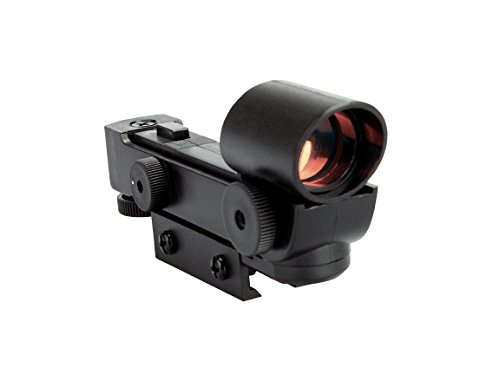
If your stock finder is broken or lost, the basic StarPointer is the low-cost fix: a red dot with adjustable brightness, its own mounting base, and a CR2032 battery included. It keeps the sky right side up. For a full comparison of dot finders, see our best red dot finders.
Finder types compared
| Type | Magnification | View | Comfort on a Dobsonian | Best for |
|---|---|---|---|---|
| Red dot | None | Naked-eye sky | Good | Bright targets, small budgets |
| Reflex sight with rings | None | Naked-eye sky with circles | Good | Chart-based pointing |
| Straight-through 8x50 | 8x | Often inverted | Poor near the zenith | Low targets |
| 9x50 RACI | 9x | Correct image | Very good | Star-hopping to faint objects |
How to align a new finder
- Do it in daylight. Point the telescope at a distant treetop or pole, at least a few hundred meters away, never near the Sun.
- Center it in the telescope with your lowest-power eyepiece.
- Adjust the finder with its screws until the dot, rings or crosshair sit on the same spot.
- Check at night on a bright star and make a small final correction.
New to aiming a Dobsonian? See how to use a Dobsonian telescope.
Frequently asked questions
Do I need a finderscope for a Dobsonian?
Yes. Through the eyepiece a Dobsonian shows only a small patch of sky (with a typical 25mm eyepiece on an 8-inch, about 1° across), so without a finder it is very hard to aim. Most come with a basic one; upgrading it is one of the cheapest improvements you can make.
Is a red dot finder or a finderscope better?
They do different jobs. A red dot or reflex sight points the telescope at what you can see by eye; an optical finderscope shows fainter stars for star-hopping. Many Dobsonian owners use one of each.
What size finderscope for an 8-inch Dobsonian?
A 9x50 or 8x50 optical finder is the common choice for an 8-inch, often paired with a zero-power reflex sight. A 50mm finder shows fainter stars than a 6x30, which helps with star-hopping, especially under darker skies.
Why is my finderscope upside down?
A basic straight-through finder has no prism, so it shows the image inverted, the same as the main telescope. A right-angle correct-image (RACI) finder uses a prism that turns the view right side up and the right way round.