As an Amazon Associate, we earn from qualifying purchases. Check the exact model, condition, delivery and current price before ordering.
- Ages 3 to 5: toy binoculars built for small hands
- Ages 6 to 9: a first real pair with a focus wheel
- Ages 10 to 14: compact 8x binoculars with real glass
- Teens: full-size 8x and 10x binoculars
- Binoculars for kids compared
- What matters in binoculars for kids
- Stargazing with kids and binoculars
- Safety: never look at the Sun through binoculars
- Binoculars, a telescope, or both?
- Frequently asked questions
The best binoculars for kids depend on age. Children from 3 to 5 do best with a 2x toy pair that needs no focusing, kids from 6 to 9 are ready for a light 3x30 pair with a focus wheel, and from about 10 a compact 8x pair with real glass prisms works for birds, sports and the Moon, as long as it closes narrow enough for the child's eyes.
Teens can use full-size 8x32 and 10x50 binoculars, the same kind adults use for birding and stargazing. The picks below are grouped by age, and every one was sold new by Amazon.com on October 28, 2026. The guide draws on makers' and dealers' specs, Audubon magazine's child test panel and a pediatric eye-spacing study; we have not tested these binoculars ourselves.
Ages 3 to 5: toy binoculars built for small hands
Preschoolers need binoculars with nothing to adjust, a strap that comes apart if it snags, and a body that survives being dropped.
1. Educational Insights GeoSafari Kidnoculars

Kidnoculars are the simplest pair here. The Amazon listing describes a fixed-focus, 2x design with extra-large eyepieces and a breakaway neck strap, made for children ages 3 and up. Because there is no focus wheel and no hinge to set, a small child can lift them and look right away, which is the whole job at this age.
Two times magnification will not bring a far-off hawk close. It does make a squirrel on the fence or a bird at the feeder look bigger, and it teaches a child to hold binoculars to both eyes and find a target. The body is plastic and not water resistant, so keep it out of the rain. The box is marked 3+ and carries a small-parts warning, so keep it away from younger siblings.
For a 3-year-old, Kidnoculars are the first pair to buy, because they have no focus to fiddle with and only 2x power.
Ages 6 to 9: a first real pair with a focus wheel
From about six, a child can learn to turn a focus wheel and squeeze two barrels together to fit their eyes. This is the age to move from a toy to a light pair with real lenses.
2. National Geographic 3x30 Kids Binoculars

This National Geographic pair is built for children. The Amazon listing describes a textured top with thumb indents for grip, a large central focus knob that is easy for kids to turn, an adjustable hinge to set the eye distance, a lanyard and a carry case. It pairs 3x magnification with 30mm objective lenses.
That combination is forgiving. Divide 30mm by 3x and you get a 10mm exit pupil, the beam of light that leaves each eyepiece. A beam that wide is easy to find even when a child holds the binoculars a little off center, so they see a picture instead of a black circle. The trade-off is reach, because 3x makes things look only three times closer. Bresser, which sells National Geographic binoculars in Europe, lists its 3x30 children's model with BK-7 prisms and a plastic body.
Ages 10 to 14: compact 8x binoculars with real glass
By about 10, children are big enough to hold an 8x compact steady enough to follow a bird, and they want binoculars that work like an adult's. Two Celestron compacts fit here. The Outland X closes to 56mm, close to the average 10-year-old's eye spacing in a large pediatric study (MacLachlan and Howland, 2002). The UpClose G2 8x21 closes only to 58mm, which suits most children from about 12 or 13, so do the fit check before buying either.
3. Celestron Outland X 8x25
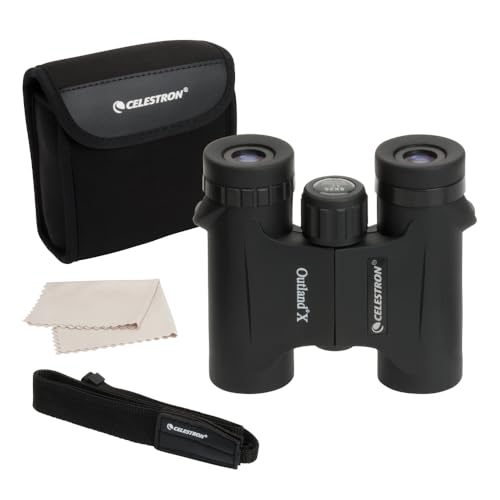
The Outland X 8x25 is the one pick here that a children's test panel tried. Audubon magazine had twelve children, ages 3 to 14, try binoculars for comfort, focus and how clearly they saw a bird picture about 25 yards away, and it named the Outland X 8x25 its step-up choice for its wide field of view, comfortable strap and eyecups, and easy focus.
The specs explain why. Celestron lists 11.5 ounces, 9.3mm of eye relief and an interpupillary range of 56 to 72mm, and Astronomics adds BaK-4 roof prisms, multi-coated lenses, an 8.2° field and a waterproof, nitrogen-filled housing. The Amazon listing adds a rubber-armored polycarbonate body. The wider field makes it easier to find a moving bird, and the waterproof body survives a wet campsite.
4. Celestron UpClose G2 8x21
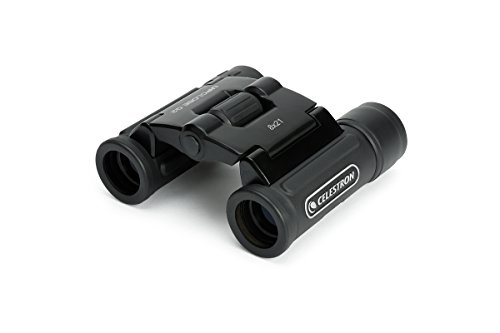
The UpClose G2 8x21 is the smallest and lightest real-optics pick. A Celestron dealer's listing (Mile High Astronomy) gives 8 ounces, an interpupillary range of 58 to 72mm, 11mm of eye relief, BK-7 prisms, multi-coated lenses and a 7.4° field of view. The Amazon listing adds a rubber-covered aluminum body, thumb indents, water resistance, a soft case and a strap.
Its weak spot is light. A 21mm lens at 8x gives a 2.6mm exit pupil, so the view darkens early in the evening and the Moon is about the only night target it shows well. For a 12- or 13-year-old who will carry binoculars in a jacket pocket, that trade is worth it; a younger child may not be able to close it narrow enough.
Nikon's Aculon A30 compacts are another real-optics choice at this age, but on October 28, 2026 the Amazon US listings showed Amazon Germany as the seller of the 8x25 and a third-party seller for the 10x25, so they have no card here.
Teens: full-size 8x and 10x binoculars
Teenagers can handle adult binoculars; use the fit check further down to confirm the eye spacing. Buy them a pair they can keep for years, for birding, travel and the night sky.
5. Celestron Nature DX 8x32
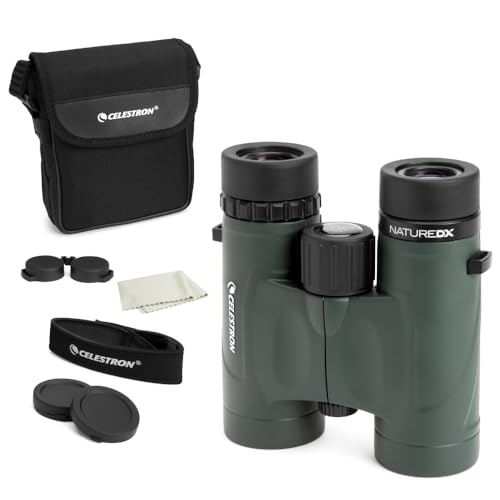
The Nature DX 8x32 is a grown-up birding binocular that a teen can carry all day. A Celestron dealer's listing (Cloudbreak Optics) gives 18 ounces, an interpupillary range of 56 to 74mm, 17.5mm of eye relief, BaK-4 prisms with phase coating, fully multi-coated lenses, a 7.4° field, 6.5 feet close focus and a tripod-adaptable body. The Amazon listing adds a waterproof, nitrogen-purged, rubber-armored housing.
Two details matter for teens. The 17.5mm eye relief lets a glasses wearer see the whole view with the eyecups twisted down, and the 6.5-foot close focus brings a butterfly two meters away into sharp view. Its 4mm exit pupil is bright enough for the Moon and the brighter star clusters too.
6. Celestron UpClose G2 10x50 (stargazing pick)
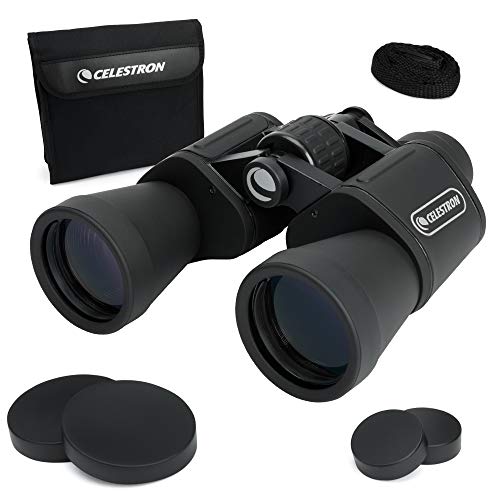
A 10x50 pair has 10x power and 50mm lenses, a standard size for astronomy binoculars. The UpClose G2 10x50 is a full-size porro pair in that size. Mile High Astronomy's dealer listing gives 27 ounces, an interpupillary range of 56 to 72mm, 12mm eye relief, a 6.8° field, a 5mm exit pupil, multi-coated optics, BK-7 prisms and a tripod-adaptable body. The Amazon listing lists a case, lens covers and a cleaning cloth in the box.
The big lenses gather about four times the light of the 25mm compacts, which is what a teen needs for star clusters and the Orion Nebula. The cost is weight and shake. At 10x, every wobble of the hands shows, so teach your teen to lean on a car roof or a fence, or add a tripod adapter.
Binoculars for kids compared
The numbers that matter most for a child are the smallest eye spacing the pair closes to, the weight, and the magnification. Blank cells mean no reliable published figure.
| Pick | Ages | Power | Weight | Eye spacing (IPD) | Exit pupil | Weather |
|---|---|---|---|---|---|---|
| GeoSafari Kidnoculars | 3 to 5 | 2x, fixed focus | No adjustment needed | Not water resistant | ||
| National Geographic 3x30 | 6 to 9 | 3x30 | Adjustable hinge | 10mm | Not waterproof | |
| Celestron Outland X 8x25 | 10 to 14 | 8x25 | 11.5 oz | 56 to 72mm | 3.1mm | Waterproof |
| Celestron UpClose G2 8x21 | 12 to 14+ | 8x21 | 8 oz | 58 to 72mm | 2.6mm | Water resistant |
| Celestron Nature DX 8x32 | Teens | 8x32 | 18 oz | 56 to 74mm | 4mm | Waterproof |
| Celestron UpClose G2 10x50 | Teens | 10x50 | 27 oz | 56 to 72mm | 5mm | Water resistant (not waterproof) |
Figures come from the Amazon listings read October 28, 2026, Bresser's National Geographic 3x30 page, and Celestron's own and dealer specification pages (Celestron, Mile High Astronomy, Astronomics, Cloudbreak Optics).
What matters in binoculars for kids
Six things decide whether a child keeps using binoculars or leaves them in a drawer. They are eye spacing, weight, magnification, eyecups, toughness and the strap. Glass quality comes after those.
Eye spacing: why adult binoculars do not fit small children
This is the number to check first. Every pair of binoculars has a minimum interpupillary distance (IPD), the narrowest the two eyepieces can get. The Celestron compacts above close to 56 or 58mm. A 1993 Pacific University optometry study (Zeise and Williams) measured average far eye spacing of 49.5mm at age 3 and 51mm at ages 4 and 5.
That gap of 5 to 8.5mm is why a preschooler looking through adult binoculars sees two circles or one black edge, gets frustrated and hands them back. It is also why the toy picks need no lining up at all, and why the National Geographic 3x30 has a big 10mm exit pupil that forgives a loose fit. Its listing does not give the narrowest hinge setting, so do the fit check below. Eye spacing widens as children grow, so repeat the fit check each year. It keeps widening through the early teens: the same study's averages are about 55 to 57mm at age 10 and 57 to 58mm at age 13, so a pair that closes to 56mm fits more 10-year-olds than one that stops at 58mm.
The quick check works at any age, and it is the one Audubon describes. Have the child start with the barrels apart and slowly push them together until they see one round circle with no black. If they still see black with the barrels fully closed, the pair is too wide for them.
Weight
Lighter is better below about 12. Kidnoculars and the 8x21 (8 oz) can hang from a neck all afternoon; the Outland X (11.5 oz) is still light; the Nature DX (18 oz) suits a teen; the 10x50 (27 oz) is a sit-down or lean-on-something binocular. Audubon's guide says a pair that weighs just over a pound is on the heavier side for kids.
Magnification and exit pupil
Low power is easier. Audubon notes that low magnification is "more forgiving in unsteady hands," and a wide field makes it easier to find what you are looking at. That is why the ladder goes 2x, 3x, then 8x. A 10x pair in a 7-year-old's hands mostly shows shake.
The second number is the lens size in millimeters. Divide it by the first number to get the exit pupil. Bigger exit pupils (10mm on the 3x30, 5mm on the 10x50) are brighter and easier to line up with the eye; small ones (2.6mm on the 8x21) need careful aim and work best in daylight.
Eyecups and glasses
Kids who wear glasses should fold or twist the eyecups down and keep their glasses on. That works only when the eye relief is long enough. The Nature DX's 17.5mm suits glasses wearers, while the Outland X's 9.3mm and the 8x21's 11mm are short, so a glasses-wearing child may see a smaller view. Children without glasses keep the eyecups up so the image stays steady against their face.
Rubber armor and water
Binoculars for kids get dropped. Rubber armor on the Outland X and Nature DX, and the rubber-covered aluminum on the UpClose G2 pairs, take knocks better than bare plastic. If the binoculars will go camping or to the beach, pick the waterproof Outland X or Nature DX.
Strap
For a preschooler, a breakaway strap (Kidnoculars has one) is the safer choice because it releases if it catches on something. Older kids need a strap that keeps the binoculars around their neck so they are not left on a bench.
Real glass or plastic
"Real binoculars for kids" usually means glass prisms and coated lenses. The Celestron picks list BK-7 or BaK-4 glass prisms and multi-coated lenses, and Bresser lists BK-7 prisms in its National Geographic 3x30. The two toy pairs do not publish their lens material, so treat them as toys, good for play and early practice, not for spotting a bird across a field.
Stargazing with kids and binoculars
Binoculars are a good first stargazing tool for a family because there is nothing to set up and children already know how to point them. Any 8x or 10x pick above shows the Moon well; the Nature DX 8x32 and especially the UpClose G2 10x50 reach further.
Start with the Moon, a few days before or after it is full. EarthSky's binocular guide suggests looking along the terminator, the line between light and shadow, where long shadows bring out craters and mountains. Then try these targets.
- Jupiter's moons: ESA's observing guide says binoculars will likely show up to four of Jupiter's large moons, Io, Europa, Ganymede and Callisto, and that they change places over several evenings. Have your child sketch them each night.
- The Pleiades: a tight cluster of blue stars in the winter evening sky that fits neatly in the view of a 10x50.
- The Orion Nebula: a soft glowing patch below Orion's belt, best from a dark spot.
- The Andromeda Galaxy: a faint smudge from a dark site, and a fun fact to tell a child, since its light left it about 2.5 million years ago.
Hold binoculars steady by leaning on a car, a fence or the back of a lawn chair, and keep sessions short for young kids. Our stargazing with kids tips cover timing, warm clothes and keeping it fun, and the kids' guide to Moon phases helps pick the best nights. For a full look at astronomy binoculars, including bigger 15x70 models, see our guide to binoculars for stargazing: best picks and how to choose.
Meteor showers are the exception. Binoculars show too little sky, so watch with eyes only. The Geminid meteor shower guide has the December dates.
Safety: never look at the Sun through binoculars
Teach this before anything else. Never point binoculars at the Sun, even for a second, and never look at a sunset through them. NASA warns that viewing any part of the bright Sun through binoculars without a special-purpose solar filter will "instantly cause severe eye injury."
Eclipse glasses do not make binoculars safe. NASA also says not to look through binoculars while wearing eclipse glasses, because the focused sunlight can burn through the filter. Only binoculars fitted with proper solar filters on the front lenses are safe for the Sun.
Three house rules help. An adult is present when binoculars come out in the daytime, the Sun stays behind you, and binoculars go back in their case when not in use, so they are never left in a sunny window. Our eclipse safety guide covers safe ways to watch the Sun.
Binoculars, a telescope, or both?
For a child under 10, binoculars are the easier first tool. They work in daylight, need no setup and go on every walk. A telescope is the next step once a child wants closer views of the Moon, Saturn's rings and Jupiter's cloud belts at night. Our guide to the best telescopes for kids goes by age the same way this page does.
For a weekend project, a DIY telescope for kids takes an afternoon, and the best astronomy books for kids tell a child what to look for. If you are shopping for a gift, the astronomy gift ideas list has more options by budget.
Frequently asked questions
What are the best binoculars for kids?
It depends on age. A 2x toy pair such as GeoSafari Kidnoculars suits ages 3 to 5, the National Geographic 3x30 suits ages 6 to 9, a Celestron Outland X 8x25 suits ages 10 to 14, the smaller UpClose G2 8x21 suits about 12 and up, and teens can use a full-size Celestron Nature DX 8x32 or UpClose G2 10x50.
Can a 2-year-old use binoculars?
Not really. Kidnoculars are made for ages 3 and up, and Bresser says its National Geographic children's binoculars are not suitable for children under 3. Audubon suggests taping two toilet paper rolls together as a practice pair for toddlers.
What age can a child use real binoculars?
Audubon's informal survey of parents and educators found that children past preschool age are generally ready for real binoculars. From about 6, a light pair with a focus wheel works; from about 10, a compact 8x pair with glass prisms that closes narrow enough for the child's eyes.
What magnification is best for a child?
Low. Use 2x to 3x for ages 3 to 9 and 8x from about 10. Low magnification is more forgiving in unsteady hands and shows a wider view, so the child finds the target. Save 10x for teens.
Why do kids see black or two circles in binoculars?
The eyepieces are wider apart than the child's eyes. The adult binoculars on this page close to 56 or 58mm, while a pediatric study measured average eye spacing of about 49.5 to 51mm at ages 3 to 5. Close the barrels fully; if black remains, choose a pair made for children.
Can you use binoculars with eyeglasses?
Yes. Fold or twist the eyecups down and keep the glasses on. Longer eye relief helps. The Celestron Nature DX 8x32 has 17.5mm, while small compacts with about 9 to 11mm show a smaller view to glasses wearers.
Which is better for a kid, 8x42 or 12x50 binoculars?
The 8x. Twelve times magnification shows every shake of a child's hands, and 12x50 pairs are heavy. For a teen who wants a bigger pair for the night sky, a 10x50 such as the Celestron UpClose G2 10x50 is a better middle ground.
Are National Geographic binoculars for kids any good?
The National Geographic 3x30 is a sensible first focusing pair for ages 6 to 9. Its Amazon listing gives a large center focus knob, an adjustable hinge and 30mm lenses; Bresser's European listing for its National Geographic 3x30 gives BK-7 prisms. Its 3x power is low, so older kids will want an 8x pair.
Can kids use binoculars for stargazing?
Yes. Even 8x compacts show craters on the Moon, and a 10x50 pair can show up to four of Jupiter's large moons, the Pleiades and the Orion Nebula. Never point them at the Sun.
Is it safe for kids to look at the Sun with binoculars?
No. NASA warns that looking at the Sun through binoculars without a special-purpose solar filter instantly causes severe eye injury, and eclipse glasses do not make binoculars safe. Only binoculars with proper solar filters on the front lenses can be used on the Sun.